Showing posts with label ABC Challenge. Show all posts

D is for Depending on the Audience

If a tree falls in the forest and no one hears it, will it make a noise? This applies perfectly to storytelling: storytelling doesn't happen without an audience. And storytellers depend on the audience in many ways.

Besides being simply a physical presence, the audience provides clues and cues for the teller. Intense listening, a questioning look, laughter, a sudden intake of breath, and even stirring in their seats all send the storyteller a message. For example:


  • A questioning look in a listener's eyes may mean the teller has used unfamiliar vocabulary. In the next sentence or two, the teller can clarify by building the definition into the story narrative.  If I said "he was feeling peckish" there might be some in the audience who would not know that Appalachian term. I could clarify by adding, "so he went looking for something to eat" which defines the word and keeps the story flowing.
  • laughter usually means the audience is with the story and comfortable enough to laugh aloud. Most people will only smile at something funny if they aren't comfortable in the environment or with the people around them. Laughter at the wrong place signals the teller to work on that section of the tale next time. Maybe he/she hadn't taken the audience deep enough into the tale, or maybe it was choice of words, or it could be simply where the event is taking place--funny in one venue might not be funny in another. I
  • An intake of breath--ah, they are really into the story and feeling what the character feels!
  • Stirring in their seats can send different messages. Stirring, looking around, whispering or talking to their neighbor very likely means "get to work, storyteller! You're losing your audience!" It could be the story was not the right one for this group; in that case the teller can shorten it up, hasten the end and move on. Sometimes inserting a question to which the audience must give some sort of response can bring them back into the tale. There are many distractions that can keep an audience from focusing: a door opening, a child crying, the lateness of the hour, too long in their seats at an event, too warm or too cold, etc. The storyteller makes lightning decisions as to what might be disturbing the group and then work with the audience to overcome the problem and get everyone back to the story. I remember one event being held in a large barn that was also used for cattle auctions. Flies were everywhere and the audience kept moving and talking to each other about it while the tellers before me were performing. When it was my turn, I acknowledged the fly problem and had everyone wave their arms in the air to scare away the flies. Everyone laughed and relaxed. The flies didn't leave, of course, but we were all more comfortable with the situation and could move along.
There are many other audience cues a storyteller will pick up on during a performance, and often the teller will make subtle changes that the listeners are not aware of. This is one reason why it is important for a storyteller to see the audience's eyes during a performance. Most performances done on stage require stage lighting; for storytelling the best lighting is if the audience lights are at least partially up so that the audience is not lost in the blinding glare of the stage lights.

Storytellers also depend on their audience for feedback after a show. Comments, memories, questions, and other interactions give us food for thought. I have heard, and been given, many good stories by listeners after a performance. A question may make me realize I need to clarify a point in the story, a hug means I have touched that person and connected with them, and that is a real reward.

So storytelling is a two-way street--the teller sends the story out, and the audience's reaction to the story feeds the teller vital information both during and long after the tale is ended.

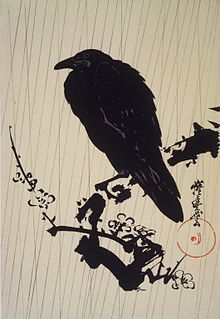
C is for Crow

Crow on a Branch - Kawanabe Kyosai(1831–1889)
A small crow was sittin' in an oak
Watchin' a tailor cuttin' out a coat. 
Hey hey-oh! said the small little crow.
Fol-de-riddle-diddle-eye-dee-oh!

So begins one of my favorite folk songs; I call it "The Crow Song," but it is also known as "The Carrion Crow," (with variations in the wording) and as a British nursery rhyme. It is one of numerous examples of how the old songs changed during their journey to the Appalachian mountains. Crows have long been associated with death, among other superstitions; perhaps calling a group of crows a "murder" has its roots in that superstition?


Seeing a "black crow" is considered bad luck, but that leaves me wondering what other kind of crow could possibly be seen, since all the crows I am familiar with are black! Are they all bad luck? Hardly seems fair to the crow. My husband calls mourning doves "rain crows" and believes that hearing one means rain is on the way. He says that his family and neighbors in southern West Virginia always called them rain crows and I had to prove to him with photos and books that his rain crows were actually doves.

The crow is often confused with the raven and the the folklore associated with each is also intermingled. The crow, in some cultures, was seen as a messenger from the gods and believed to be the bringer of messages of prophecy and either good or bad omens.

Some other superstitions attached to crows:
  • a dead crow in the road is a sign of good luck (but not, apparently, for the crow). This probably comes from the practice of hanging a dead crow in the garden to frighten off other crows. As one old-timer told me, "The only good crow is a dead crow."
  • Seeing two crows flying together is considered good luck in some places, but bad luck in others. I guess it all depends on where you live.
  • a crow on the roof means Death is on the way to the house.
  • A Missoula cemetery website offers this advice: "One crow = Bad luck. Two crows = Good luck. Three crows = Health. Four crows =Sickness. Five crows = Death. Lots of other interesting graveyard folklore in this document.

My husband's father once had a crow as a pet. We know now, of course, that it isn't wise and is in fact illegal generally to keep wild creatures as pets, but back in the 1950's no one thought much about it. Chuck (Larry's dad) had a variety of wild animal pets from time to time: raccoons, groundhogs, squirrels, a fox--so when he found a baby crow he naturally brought it home. The family raised the crow on a doll bottle at first, then gradually moved on to other foods as the crow, now named Jimmy, grew. They had him for 7 years until an unfortunate argument between Jimmy and the hogs lead to Jimmy's demise. Larry has many tales about his crow, and some of them have become a story I sometimes tell.

Crows feature in the folklore and stories from countries around the world. Wikipedia says that "In Chinese mythology, the world originally had ten suns either spiritually embodied as ten crows and/or carried by ten crows: when all ten decided to rise at once the effect was devastating to crops, so the gods sent their greatest archer Houyi, who shot down nine crows and spared only one. This mythology comes from a text in Shanhaijing, among other sources.[49]

Aesop certainly knew a thing or two about crows; the story of the crow and the pitcher is a good example:

A Crow, half-dead with thirst, came upon a Pitcher which had once been full of water; but when the Crow put its beak into the mouth of the Pitcher he found that only very little water was left in it, and that he could not reach far enough down to get at it. He tried, and he tried, but at last had to give up in despair. Then a thought came to him, and he took a pebble and dropped it into the Pitcher. Then he took another pebble and dropped it into the Pitcher. Then he took another pebble and dropped that into the Pitcher. Then he took another pebble and dropped that into the Pitcher. Then he took another pebble and dropped that into the Pitcher. Then he took another pebble and dropped that into the Pitcher. At last, at last, he saw the water mount up near him, and after casting in a few more pebbles he was able to quench his thirst and save his life.


This reminds me of Mark Twain's story about the blue jay trying to fill a cabin by dropping acorns down the chimney. The result was a bit better for the crow trying to fill his pitcher, a more reasonable goal.

My Dad used to say this about planting corn: "one for the rain, one for the drought, one for the crow and one for me." This is close to a saying collected by the Missouri Folklore Society: "One for the rook, one for the crow, one to rot, and one to grow."

Other crow stories and songs:
The Fox and the Crow, from Aesop: Wikipedia gives information and links to many versions of this fable, including musical ones.

The Native American tale Rainbow Crow is retold by S.E. Schlosser here. You can find many legends of the Native American Crow people on this site.

Story-Lovers has a plethora of links, books and more, all about crows.

Crows continue to intrigue scientists too. Find out about some current research and findings at the Cornell website.

I'll wrap up this post with another favorite ballad called The Twa Corbies. It's also known as The Two Crows. Some years back a storyteller whose name I cannot recall taught it to me as Biddy McGee McGaw which is very close to this version, also from the Appalachian mountain region:


"The Three Black Crows." 
Obtained from Miss Mary Franklin, Cross­nore, Avery County, North Carolina, August n, 1930. (From the Traditional Music website
1. There were three crows sat on a tree,
   Old Billy McGaw McGee!
There were three crows sat on a tree,
Old Billy McGaw McGee!
There were three crows sat on a tree,
And they were black as crows could be,
And they all flapped their wings and cried,
"Caw! Caw! Caw!"
And they all flapped their wings and cried,
"Caw! Caw! Caw!"
2. "What shall we have for bread to eat?"
    Old Billy McGaw McGee!
"On yonders hill there lies a horse."
Old Billy McGaw McGee!
"We'll perch ourselves on his backbone,
And pick his eyes out one by one;"
And they all clapped their wings and cried,
"Caw! Caw! Caw!"
And they all clapped their wings and cried,
"Caw! Caw! Caw!"


B is for Ballad

Continuing the ABC challenge which I have decided to make my theme for this blog until I reach the end of the alphabet. I will be madly scrambling to find a post for a few of the letters, I think!

Ballads: what are they? Probably most of us studied ballads as a poetic form when we were in school but I am referring to the songs. Ballads have been in existence since before written history probably; they are the songs of the troubadours who wandered from town to town, spreading the news in song. They are the songs of farmers and shepherds and milkmaids, of soldiers and forlorn lovers. Ballads tell stories of sadness, of violence, good deeds and evil deeds, of love lost and also love found; the stories of battle victories and defeats, of hopelessness and despair, grief, and joy. Sometimes they are also hilarious and ribald, but always they tell stories.

That is what drew me to ballads when I was fairly new to storytelling. I was listening to every storyteller and story I could find, exploring styles and story types when I stumbled on a CD of Appalachian ballads sung by Doug and Jack Wallen of North Carolina. I was hooked, and then amazed to find that I could sing along with them. Me, who never sang because I thought I couldn't! I began exploring this old style of storytelling and then began learning ballads, one by one. I was not in the fortunate position of having an oldtime singer living nearby so I had to learn from recordings, the occasional meetup with other singers, and even matching words with midi files online to get the tune to one I wanted to learn.

from wikimedia commons
And I read and read and read. I learned that those mysterious "Child ballads" were really just ballads collected by Francis James Child, a poor boy who became a Harvard Dean and traveled to England to collect the songs he had become fascinated with. Thank goodness for him; had he not caught the songs when he did, who knows what might have happened to them? People in the British Isles had all but stopped singing the tunes when Child arrived; he consulted other collectors, worked with historical collections and eventually published his 10 volume work called English and Scottish Popular Ballads. It remains the most complete work ever done on the topic.

from wikipedia
What Child didn't know was that in America the old songs were still being sung, particularly in the Appalachian mountains. Some changes had been made here and there to reflect the ballads' new home but for the most part they were intact.

from Western Carolina Unversity
It took Olive Dame Campbell, wife of John C. Campbell, and founder of the folk school that bears his name in North Carolina, to notice the strange tunes being sung by the mountain people she had come to work with. Olive Dame Campbell noted the melodies and lyrics as best she could and took her collection to Cecil Sharp. Sharp was an English scholar of sword dances and folklore and he was so excited by Campbell's find that he immediately began fundraising for a trip to the mountains to find the songs for himself, and to record them on what was at the time state-of-the-art wax cylinders. Sharp made two trips to the Appalachians, and published his discoveries in his book Folk Songs of the Southern Appalachians. He was assisted in his work by Maud Karpeles and after Sharp's untimely death she continued to publish his findings.

There were the broadside ballads, too--those songs written by an unknown hand and sold on the streets for a penny or two. Many have passed down into the oral tradition to become standards of the genre. Pretty Polly, Pretty Saro and Butcher's Boy are ballads I sing that fall into this category.

Ballads often have "traveling verses," or verses that occur in several different songs. The most familiar of these is the verse about a rose springing from the grave of the one who was true and a brier from the grave of the one who was not, and twining together over the graveyard gate to form a lover's knot.

There have been many other songcatchers in the Appalachians: John Harrington Cox, Alan and John Lomax and others, but Cecil Sharp's work was like the lifting of a veil. Today ballad-singing is perhaps not as popular even in these hills as it once was but there are still singers like Sheila Kay Adams, Elizabeth LaPrelle and Bobby McMillion who continue singing the songs passed down to them through their families. And there are singers like me, latecomers to these hills who have found their voice in the mountain ballad.