Showing posts with label Granny Sue. Show all posts

Who Haunts Sliding Hill?

Salt furnaces. Coal mines. A beautiful river. And a murder.

Sliding Hill, located in Mason County, West Virginia, has been the site of all of the above.


Sliding Hill is located between the towns of New Haven and Mason, not far from the community of Hartford. Today it is a quiet little place; most residents of the area probably work at the nearby power plant. But in its heyday this stretch of the Ohio River was teeming with people and excitement.

The towns of New Haven and Hartford were named, as you may have guessed, by settlers and entrepreneurs who came to the valley of the Ohio from Connecticut, and named the new settlements after their old homes. In 1856 salt works were built in the area. 

photo of the Jackson Salt Works, from http://www.wvgenweb.org/mason/hartford/hart.html

Processing the salt required coal to fuel the furnaces, so coal mining also became a big industry. With the location of Mason county on the Ohio River, shipment of the salt via steamboat was an easy affair, and the coming of the railroad in the 1880's expedited exports even more. Dairy farming became a growing industry in the rich river bottoms as well. 

In 1774 a major battle in Lord Dunmore's War occurred at Point Pleasant, VA (now West Virginia). This battle officially drove the Native Americans back across the Ohio River, although raids continued for years after the Treat of Camp Charlotte was signed. 

One of the stories about the haunting of Sliding Hill is loosely connected to the fort at Point Pleasant (Fort Randolph). According to this story, an army paymaster was making his way along the river to the fort, carrying with him a quantity of gold with which to pay the soldiers at the fort. A gang of robbers set upon the paymaster and killed him. Hearing soldiers approaching, the thieves quickly left the area, after first hiding the body and burying the gold. Legend has it that the gold was never recovered, and that the area is haunted by the ghost of a man walking along the road.

A dark spot along the road. "Perfect place for a murder," was Jared's comment.
Sliding Hill Creek, a little muddy after all the recent rain.
Two things in this story seem odd to me: first, that the paymaster should have been traveling alone. Surely in those dangerous times, when attacks by Indians were common and the route was a lonely one, there would have been at least one other man with the paymaster. Second, how in the world would there have been time to hide a body and bury the gold? Why would they have buried the gold anyway, if they had time enough to get away? 

The second story of a haunt in the Sliding Hill area was reported in this old newspaper article:


This version, the murder of early settlers who were traveling by canoe and stopped to camp on the riverbank, makes more sense to me, although the statement that they had "much gold" with them seems odd. Why would one carry a lot of gold into the wilderness? Still, it could have been true. It seems unlikely, however, that the robbers would not have come back for the rest of the gold. With so few people in the area, what would have prevented them from recovering it? 

Whichever version is the true story, the belief that an area along the road by Sliding Hill is haunted seems to have been well established. And the sightings reported sound frightening indeed. I suppose we will never know the truth of the story, who was killed and when or by whom.

I wonder, are the ghosts described as horrific haunts on Sliding Hill still wandering, or have they settled gently into their graves after all these years? 

I suppose I will never know the answer to that, either. Only the river would know, and she's not talking.

New CD Now Available!

I am pleased to announce the release of my latest CD, Idy Mae's Full Moon and Other Stories and Songs.


The CD has stories from my husband's childhood in a West Virginia coal camp along with tall tales and songs. It's guaranteed entertainment for the whole family.

You may buy directly from me, or wait a few days and it will also be available on CDBaby and Amazon. Price is $15.00 (with free shipping if you buy from me!) Just click on this link to my other blog, Granny Sue's News and Reviews, and click on the Buy Now button on the right, or email me at susannaholstein@yahoo.com and I can send you particulars.

Another CD of ghost stories is in the works and should be ready for release in about 6 weeks, so stay tuned!

Holiday Traditions of Childhood

I was raised in a large family---a lot of love but not much money. Extravagant gifts were not an option. We had to find other ways to make our holidays merry and bright. Now I find that many of the things we did are right in vogue as people look for ways to consume less, enjoy more, and live more gently on this earth.


My mother, a British WW II war bride, brought many holiday traditions to the US with her. She started the day after Thanksgiving--that was Fruitcake Day. When the batter was ready, everyone stirred three times each and made a wish. This was the signal that the holiday season had officially begun.

Saint Nicholas Day was the next holiday event. On December 6th Mom would wrap small gifts for each of us--a pencil, eraser, handkerchief--nothing expensive, but the gift beside our plates at dinner was always exciting. She usually re-used wrapping paper from the year before for these tiny gifts.


The Christmas Parade: We never missed it! The parade, held at night, passed the corner of our street. We'd bundle up and wave to the floats and to Santa at the end, then rush home for hot chocolate. Sometimes we'd go caroling in the neighborhood, stopping in at different houses to visit briefly and enjoy cookies and maybe some hot chocolate.


The Manger: Mom set up her nativity scene at the beginning of Advent, but the manger would remain empty until midnight on Christmas Eve. The Wise Men were also not present---they began their journey on the other side of the living room, moving a little each day until they finally arrived on January 5th, Epiphany.

The empty cradle was a challenge. In order for the baby Jesus to have a soft bed, we had to do good deeds, each one rewarded with a straw for the cradle. Some years I'm afraid His bed was a little hard! We stayed mindful of that cradle all month, and tried to do things that would earn a straw to add to the pile.

The Christmas Elf: this little fellow also moved about the house, watching children and reporting on behavior to Santa. We didn't want to be caught being naughty if the Elf was watching.

Cleaning: "You can't decorate dirt," Mom would say. So we'd polish the old house until everything shone--silver, wood, brass, mirrors. The house would be fragrant with the smell of floor wax and lemon oil. Then it was time to put up the tree and decorations.


The kissing ball: Mom re-decorated the ball each year with ribbons and greenery, and hung a sprig of mistletoe in the center. When we got older, we were allowed to help. She used scraps from sewing, ribbons from packages, any little bits and pieces she could find to make it glittering and pretty. It was usually hung in the dining room door and I can remember Dad catching her under it many times. We all loved to see them kiss.

The tree: Always a live one that we cut on a friend's farm, it was always lopsided and oddly shaped, and always decorated by Santa after midnight Mass. The tree would be put up a few days before Christmas, and the lights strung. The living room ceiling was twelve feet high, and the trees usually had to be trimmed to fit under them.


Decorations: lopped-off branches from the Christmas tree, holly, and a vine we called running pine were the main ingredients for our decorations. Greens were piled atop the mantles, around the front door, and twined down the stairs. Red ribbons and gold beads were added as we vied with each other for the best trimmings, re-used year after year and carefully stored away.

Yule log: made from a piece of the trunk of a former Christmas tree, Dad drilled small holes in it that we filled with greenery and Christmas bits of glittery stuff. Three larger holes held candles. The Yule log was always on the mantle in the living room, and the candles were lit on Christmas Eve to light in the Christ Child. A candle was placed in the window for the same purpose.

Christmas Day: On Christmas morning, we could see the tree through the crack between the big sliding wooden doors of the living room. It was shining and glimmering in the dusky light of dawn, and when the doors were finally opened--only after every single person in the house was present--it was a wondrous sight to behold. My parents collected Christmas balls, adding a few each year, making some, getting some for gifts. My last year at home, over 1000 balls hung on the green branches.


Gifts: with thirteen children to buy for, money didn't go far. We liked to buy for each other too but our money was practically non-existent. We learned to be happy with small gifts. Stockings were stuffed with apples, oranges, and nuts. We'd buy a pack of pencils and wrap one for each sibling, or penny candy, and wrap the gifts as carefully as if they had great value. They did--our hearts were in them. It didn't matter that the gifts under the tree were small--there were plenty of them and the joy when they were unwrapped was genuine. We’d have to hurry to get ready for early Mass at 7:30am.


Open House: Homemade eggnog, the fruitcake, and many other homemade goodies graced the table on Christmas night as friends and family came to visit. What happy times those were for a kid--lots of good things to eat, lots of noise, people singing carols, laughter. We baked for days before Christmas to prepare, always the same traditional fare--sausage rolls, mincemeat pies, wedding cookies, stollen (a sweet bread flavored with almond and laced with candied cherries), date bars, decorated sugar cookies, and so on.

Boxing day: this was the day after Christmas when we went visiting, usually wearing some of our gifts (mittens or toboggan hats knit by Mom, or new socks or a hanky from Granny).


New Year's Eve: even the littlest ones were allowed to stay up and see the New Year in, although they seldom stayed awake until midnight. Unspiked eggnog for the children and perhaps something a little stouter for the parents! Leftover goodies from Christmas, along with ham and rolls, were placed on the table once again for a repeat of the holiday feast.

Epiphany, January 5th: On this day our Wise Men finally made it to the crèche, and since they gave gifts to the Child, we also received small gifts at our places at dinner. This ended the 12 days of Christmas for us, although the tree remained decorated in all its glory until January 11th, my parents' anniversary and the occasion for more merrymaking.

And then the holidays were officially over, the decorations were regretfully taken down, and we looked ahead to the start of the next season--and by then it was only 10 and a half months away!

The Book Launch: Voices on Unity


Last night's book launch party was so much fun! It was a pleasure to see so many writer friends there, some with stories in the book and some who just came to support and listen. The books the publisher brought to sell sold out and the ones I wanted will be mailed to me. Now that's success.

The stories were fantastic--from a young woman's memories of the Women's March to tales of healing, stories that brought tears, laughter, thoughtful silence, intent listening. I have been reading the book today and am humbled to have my story be in such company.

And I am inspired to write more often. I have so many interests, too many I sometimes think, and it is difficult to carve out the quiet, reflective time it takes to write. Writing this blog is like writing a letter to friends and it keeps me thinking about writing, which is a good thing. Sometimes I feel like I am hanging on to that part of me by a thin thread. Then I go to a workshop or an event like this and come home recharged.


If you would like a copy of Voices on Unity: Coming Together, Falling Apart, just click on the Buy It Now Link in the sidebar, or send me a message at the email address that is also in the sidebar and we can work out how to get your book to you. You will not be disappointed, I promise.

Copyright Susanna Holstein. All rights reserved. No Republication or Redistribution Allowed without attribution to Susanna Holstein.

Mistletoe: Legend and Lore

While searching for folklore and legends about mistletoe, I came upon a reference to a ballad called "The Mistletoe Bough." Of course that sent me searching for lyrics, melody and more information.
What I found was intriguing: a ghost story, set at Christmas time, that is also a tragic love story, written as a poem that was later set to music. Opinions differ on the location of the story's events, the time they supposedly occurred, when the poem was written and even if it is a true story or merely a romantic tale.

The story apparently struck a chord with many people over the years. The ballad has been recorded by artists even recently (and available as a ringtone!). The story has been performed as a play and as a pantomime.

Something else that I found interesting was that the name of the young lady's lover, Lord Lovell, is the title of yet another ballad. Is it one and the same man? Proably not, but an odd coincidence all the same.

The ballad/poem continues to draw lovers of old mysteries and the singers of today. And if you should happen to buy an old English trunk, you might find that what you have was the final resting place of the young lady in the song.
This is the ballad version of the poem:
The Mistletoe Bough

by Thomas Haynes Bayley


The mistletoe hung in the castle hall
The holly branch shone on the old oak wall.
The Baron's retainers were blithe and gay,
Keeping the Christmas holiday.
The Baron beheld with a father's pride
His beautiful child, Lord Lovell's bride.
And she, with her bright eyes seemed to be
The star of that goodly company.
Oh, the mistletoe bough.


"I'm weary of dancing, now," she cried;
"Here, tarry a moment, I'll hide, I'll hide,
And, Lovell, be sure you're the first to trace
The clue to my secret hiding place."
Away she ran, and her friends began
Each tower to search and each nook to scan.
And young Lovell cried, "Oh, where do you hide?
I'm lonesome without you, my own fair bride."
Oh, the mistletoe bough.

They sought her that night, they sought her next day,
They sought her in vain when a week passed away.
In the highest, the lowest, the loneliest spot,
Young Lovell sought wildly, but found her not.
The years passed by and their brief at last
Was told as a sorrowful tale long past.
When Lovell appeared, all the children cried,
"See the old man weeps for his fairy bride."
Oh, the mistletoe bough.

At length, an old chest that had long laid hid
Was found in the castle; they raised the lid.
A skeleton form lay mouldering there
In the bridal wreath of that lady fair.
How sad the day when in sportive jest
She hid from her lord in the old oak chest,
It closed with a spring and a dreadful doom,
And the bride lay clasped in a living tomb.
Oh, the mistletoe bough.
Here is the poem:

The Mistletoe Bough

by Thomas Haynes Bayly (spelled variously in different documents, as you can see)
The mistletoe hung in the castle hall,
The holly branch shone on the old oak wall;
And the baron's retainers were blithe and gay,
And keeping their Christmas holiday.


The baron beheld with a father's pride
His beautiful child, young Lovell's bride;
While she with her bright eyes seemed to be
The star of the goodly company.

'I'm weary of dancing now," she cried;
"Here, tarry a moment - I'll hide - I'll hide!
And, Lovell, be sure thou'rt first to trace
The clew to my secret lurking place."

Away she ran - and her friends began
Each tower to search, and each nook to scan;
And young Lovell cried, "O, where dost thou hide?
I'm lonesome without thee, my own dear bride."

They sought her that night! and they sought her next day!
And they sought her in vain while a week passed away!
In the highest, the lowest, the loneliest spot,
Young Lovell sought wildly - but found her not.

And years flew by, and their grief at last
Was told as a sorrowful tale long past;
And when Lovell appeared the children cried,
"See! the old man weeps for his fairy bride."

At length an oak chest, that had long lain hid,
Was found in the castle-they raised the lid,
And a skeleton form lay moldering there
In the bridal wreath of that lady fair!

0, sad was her fate!-in sportive jest
She hid from her lord in the old oak chest.
It closed with a spring!-and, dreadful doom,
The bride lay clasp’d in her living tomb!

So there's the story. Now for all the background sources:
Information and the melody of the ballad can be found at this website.
This site offers a brief background of the song and its origins, but for a full, detailed history of the song from the book, Stories of Famous Songs, go here.
One version of the ballad, and a link to a sung version that didn't work for me; perhaps you will have better luck.
A little more trivia about the poem and the place where the events supposedly happened.
The poem arranged as a play--an interesting idea for a Christmas play, if a bit on the dark side.
A New York Times article from 1877 about a pantomime performance of the story.
Today you can have the song as a cell phone ringtone performed by Nick Cave and the Bad Seeds.
Anthony Trollope's story of the same name speaks more of romance than folklore.
An entirely different poem by the same name, by American poet Ellis Parker Butler (b.1869, d.1937).
There you have it: The Mistletoe Bough in many shapes and forms. It wasn't what I started to research, but I found myself following the trail of this old story, and thought many of you might find it as interesting as I did.
Caroling Program Scheduled in Ripley

from the Parkersburg News & Sentinel, Parkersburg, WV

RIPLEY — The history of caroling is coming to Alpine Theatre in Ripley on Nov. 26.

Storyteller Susanna “Granny Sue” Holstein and musician Jeff Seager have been a-caroling across the region for more than five years. They are bringing their sing-along folk performance to Ripley.

“Here We Come A-Caroling” is a combination of Christmas carols and the stories behind the songs and will be presentee at 2 p.m. Nov. 26 in the historic Alpine Theatre, 210 W. Main St., Ripley.

Admission at the Alpine is $10 for adults and $5 for senior citizens and students.

“I have always loved carols,” said Holstein, whose mother was a World War II bride from England. “Mom brought many of her English customs and folklore with her to America, especially the Christmas ones.”

That meant she grew up with plum puddings, fruitcakes and a mistletoe ball in the house.

“We also grew up with carols,” she said. “Mom would play them from the beginning of December until the 12th night, and we often sang them as a family. Sometimes we went caroling in our neighborhood.”

The West Virginia History Hero recipient from Sandyville learned that she had a common interest in the songs with Seager, a guitarist from South Charleston. A conversation led to the development of the program.

Seager says they have performed in state parks, libraries and churches.

“Each year we find more songs that have intriguing stories behind them, so our repertoire keeps changing,” he said. “Many of the songs we perform have Appalachian connections. Some are versions of old songs from the British Isles and others were written right here in the mountains.”

Songs range from “The Huron Carol,” from the 17th century Native Americans. It was the first carol written on the continent. Among the more modern tunes, “Frosty the Snowman” was written by West Virginian Jack Rollins. “Silent Night” is popular in multiple languages.

Holstein has been storytelling as “Granny Sue” for more than 20 years. She leads the annual “Do You Believe?” ghost walk through downtown Ripley each October.

Coming Soon: Voices on Unity

Coming soon: Voices on Unity

It will be here soon! And my story about making fruitcakes with my sisters will be in it, along with stories and poems from many other fine West Virginia writers.


Voices on Unity: Coming Together, Falling Apart is the new anthology soon to be released by Mountain State Press.  The book launch event will be held Tuesday, December 12, from 6:00pm-8:00pm at Hidden Creek Mercantile, The Copper Room, 2803 Main St, Hurricane, WV.

Contributing writers will be there reading from their stories. And you know, this weekend I'm making fruitcakes with my sisters again so if they come out well, I might just bring some with me to the launch!

I am excited about this book, which has stories and poems from many perspectives. In this time of national divisiveness, a collection like this is timely and needed. I am indebted to editor and publisher Cat Pleska, for envisioning and nurturing this project to completion.

I hope you can join us on December 12 to celebrate the launch of this exciting new work.

Meeting the Devil and Mixed Up Girls

A woman we met at a restaurant in town told us this story. She was having dinner with her parents and had overheard us telling a friend that we were going to Matewan and Mingo county the next day.

"I'm sorry," she said. "I don't mean to interrupt you, but we're from Mingo county!"

The world throws strange coincidences our way, doesn't it? We stayed and talked with these nice people for probably half an hour. West Virginians are like that--we talk to strangers and end up being friends by the end of the conversation. And we hear some good stories in the process, like this one.

The mother at the table said that her grandfather (or maybe it was great-grandfather) had a store at the top of Ben's Creek Mountain in Mingo county. The mountain is known for its foggy conditions, and one night as her grandfather was riding home on horseback he found himself enveloped in a thick, almost impenetrable fog. He's been out late and he'd had a bit too much to drink, so between the fog and his foggy brain it was a difficult ride.

from Microsoft Clipart
He was making his way his way slowly along the narrow track when his horse suddenly stopped. A quick look revealed the reason: the Devil Himself was holding the horse's bridle.

The horse stomped and tried to rear, laying back its ears and rolling its eyes in fright. "Turn loose of my horse!" the grandfather shouted. He was scared too, but drink can make a man braver than he might normally be in such a situation.

The Devil replied, "You keep drinking like that and you'll be mine in the end. You better stop your drinking, old man."

And then the Devil disappeared. The old man, probably feeling even older after that encounter, continued on to his home.

"So," I asked, "did your grandfather stop drinking?"

"No," the lady who told the story replied, "he said he just quit riding over Ben's Creek Mountain in the dark!"

While we were in Matewan, the man we met in the restaurant there told us this story:

photo from History of Colorado
There was an elderly man who lived somewhere close to Matewan (he named the man's name, but I cannot remember it now) who had six daughters and one son. The old man had always lived a simple life, cooking with wood or coal, and an outside privy for a bathroom.

The girls grew up and moved away to Cincinnati, Cleveland and other places where they all prospered and had good lives. They decided that it was time for life to be a little easier for their father too, so they devised a plan to go home and fix up the house for the old man.

They did it up right--all modern conveniences in the kitchen, and a bathroom complete with shower, sink and toilet. When the work was finished, the sisters threw a party--an outdoor cookout. They bought a grill, picnic table, steaks, the works. While they were eating, their father spoke up.

"You girls have got it all mixed up! What are they a-teachin' you in those cities? You've got it all backwards!"

"What do you mean, Dad?" The women were surprised and confused by his comments.

"You're eating outside and going to the bathroom in the house! That's not how it's supposed to be! You're supposed to eat in the house and use the bathroom outside. You've got it all backwards!"

A Classic Appalachian Story for Halloween

This is one of my favorites, the old Appalachian tale of the Tailypo. Spellings and tellings of this story vary from one storyteller to the next, but the gist of the tale remains the same.

Listen, then tell it to someone this Halloween season!


Ghost Stories Season!

This will be a busy week for storytelling!

I have some private events, but these are open to the public. I hope to see you at one of them!

Wednesday, October 11, Jackson's Mill, Weston WV. 7:00pm, in the Assembly Hall. Storytellers Granny Sue, Adam Booth, Marc Harshman and Ilene Evans.


Thursday, October 12: Philippi Library, Philippi, WV, 4:00pm. West Virginia Ghost Stories with Granny Sue.


Friday and Saturday, 6:30 and 8:00pm each night: Believe It or Not Ghost Walk, downtown Ripley, WV. Meet at the Court Street side of the Courthouse. Ghost, murders, hangings, graveyard and more!


Summer Reading 2017: Stories for a Better World

Summer seems like a long way off in these dreary days of February. But for a storyteller, summer is just around the corner, and this is the time to be busy planning and practicing for summer shows.


My summers are usually filled with library summer reading programs, and it's something I look forward to every year. This year I am focusing once again on the national theme for the libraries, Build A Better World. It's fantastic for a storyteller because most stories are meant to do exactly that--stories teach, inspire, and encourage us, not through outright "do this" statements, but through words that make us understand what is right and good, how we should behave and how goodness can be rewarded. Folktales were, after all, the original media.

Several performances are already scheduled. I hope your local library will consider having me come!


Christmas! Lore, Recipes, Stories, and More


I have compiled a list of posts from my other blog that have ideas, stories, crafts, folklore, traditions and more about this holiday season.


From Yule and Solstice to Old Christmas to elves and paper stars and simple gifts to make, there is a bit of something for everyone in the list below.

Enjoy!


Mincemeat and the mincemeat tarts recipe

Here We Come A-Caroling!

Here We Come A-Caroling!

 My mind has been filled with carols these past few weeks as I practice and research for the upcoming Here We Come A-Caroling! program. I present this show with my friend, folk musician Jeff Seager, and each year we add new stories and songs to our performance. This year's new songs include:
  • Nova! Nova!, a medieval carol with an interesting construction
  • Beautiful Star of Bethlehem, a carol written in an Appalachian cow barn
  • Welcome Yule!, a hearty welcome to the coming of Solstice
There will be stories that tell the history and lore behind each of these carols as well as all of the other carols included in our program. Some favorites, such as The Huron Carol and Don in Yon Forest are also on the agenda. Recently I learned of a family connection to the Christmas Truce of 1914, and that story will be included in our rendition of Silent Night.


From last year's fun: attendees playing parts with masks for an old
Appalachian song.
There is so much more--there is such a wealth of carols! And there is fascinating lore too--the traditions, superstititions, prohibitions, etc. connected with our celebrations of the holidays. Holly, ivy, the bringing in of greenery, the food customs, ways to assure good luck and fortune, finding a mate, the Yule log...it's not what to include, it's how much we can manage in the time we will have.

Here is the schedule of our performances so far. Call or email me for more information. I hope to see you at one of these events!

  • NOVEMBER 28: HERE WE COME A-CAROLING, CEDAR LAKES, RIPLEY, WV 7:00PM, ROAD SCHOLARS PROGRAM.
  • DECEMBER 10: HERE WE COME A-CAROLING! HOUSE CONCERT, FREDERICK, MD. 7:00PM. CONTACT ME FOR DETAILS.
  • DECEMBER 11: OLDE TYME CHRISTMAS, HARPER'S FERRY, WV, ST. PETER'S CHURCH, 1:00PM, FREE PUBLIC PROGRAM.
  • DECEMBER 17: HERE WE COME A-CAROLING! PHILIPPI PUBLIC LIBRARY, PHILIPPI, WV 2:00PM, FREE PUBLIC PROGRAM.
  • DECEMBER 18: HERE WE COME A-CAROLING! BLACKWATER FALLS STATE PARK, DAVIS, WV 10:00AM, FOR BREAKFAST WITH SANTA PROGRAM.

Ghostly Wanderings: The Storytelling Trail

Ghost stories season is beginning to wind down but it's been a busy time the past week for this tale teller.

Last weekend I presented two ghost walks in Ripley, WV, a mile-long stroll through stories of "mystery and history," as the director of the local Convention and Visitors Bureau called it. The walks are sponsored by the CVB and have become a popular annual tradition. Each year I research new stories to add and new tidbits from history to enhance the walk because many people return for the walk each year.

Over 100 people came out Saturday night for the ghost walk

The ghost walk was followed by a drive across West Virginia to the eastern county of Grant, where I told stories at the Grant County Library in Petersburg. A crowd of 50 turned out for the Monday night event. The audience included everyone from small children to senior citizens, so I had stories for all ages in my program.


While in Grant county, we took time to visit the Dolly Sods Wilderness area, one of West Virginia's most beautiful scenic areas. It was a very windy day and we had to be careful as we ventured onto the rocks to be sure we weren't blown over the edge! 

I remember when we camped on Dolly Sods about 15 years ago. An elderly gentleman camped nearby told us that he was one of the Dolly family for whom the rocks are named. Dolly Sods is known for its abundance of wild blueberries and huckleberries, which attract both humans and bears in the summer months. 

This gentleman said that when he was a boy they often spent days on the mountain picking berries, and that every 4 years or so someone would set fire to the mountain. Why? I asked. Well, he said, the brush would get to growing and crowding out the berry patches, so they'd burn it off to let the berry plants grow. That practice had to stop once the government took over management of the land. This reminded me of stories about the Native Americans burning off land so that the blackberries would come back in thicker and better.

We left to drive to central West Virginia for storytelling at a school in a small community that was a victim of the terrible June "thousand-year" flood. I had a great time telling tales at Birch River Elementary. I think the best--and most touching--part of the day was being interviewed by two 5th grade students. One of their first questions was, "Were you presonally affected by the floods?" They went on to describe some of the damage in their area. I did not suffer any damage to my home from the flood, but in this state we're all family, and what hurts one hurts us all. Thank you, boys, for reminding me of that.

In the few days remaining in this month I'll be storytelling at three more schools: for eighth grade students in Kanawha county, high school students in Putnam county, and elementary students in the northern panhandle town of Follansbee. I finish up with an evening of ghost stories at the south Parkersburg library. 

It's been a good month telling my favorite kind of story! Check out my upcoming performances here, and maybe I will see you at an event in the near future.

October Schedule: Lots of Ghostliness

October is filling up with ghosties! I hope I will see you at one of these events:

October 6: Ripley, WV Middle School full day storytelling

October 10: Tamarack, tour group presentation. Private event.

October 11: Philippi Library, Philippi, WV. WV Ghost Stories, 4:00 for Teen Read Week

October 12-13: West Virginia Storytelling Festival, Weston, WV. Schools event and evening public performance.

October 15: Apple Butter Making at my house!

October 17: Mountaineer Tours, Tamarack, Beckley, WV. Private event.

October 21: Road Scholars presentation, Beckley, WV 9 am

October 21-22: Ripley Ghost Walk, 8pm each evening.


October 25: Grant County (WV) Library, Ghost Stories tentative

October 28: Hurricane High School, Hurricane, WV. Storytelling and workshop

October 31: Jefferson Elementary, Follansbee, WV. Ghost stories all day

October 31: South Parkersburg (WV) Library, Ghost stories, 6:30pm

Til then, happy haunting!

Family and Stories

Ernest Thomas Hagger, courtesy of Julie Day
It's been a quiet week for storytelling, and May will be a quiet month altogether for me, but that's okay because with 3 graduations, the Connelly family reunion and our 30th anniversary this month, it's going to be a very busy time with family events. 

Family is really the heart of our lives, and of our stories. The stories I tell often reflect my upbringing--values, morals, ethics, and just as often might be about my family. 


The new story I am working on is about a grandfather I never knew but who is now as real to me as I'd sat on his lap, thanks to the diligent work of my cousin Julie in England. 

So many stories are hidden in our genealogy. And yet many of us wait until those who might know about the people and events of past generations are gone too. We are fortunate that one aunt is still living and still remembers. Find that one in your family, and ask the questions now, before the answers are buried with your elders.


Christmas Lore: The Christmas Tree

Good morning!

I spent some time reading up on the history of the Christmas tree this morning while I drank my tea. My friend Jeff and I are putting together our Christmas carols program and adding new material for this year's presentations. I always enjoy the research as we prepare the songs and stories each year.

The tree is another example of the blending of earlier pagan beliefs with the symbols and beliefs of Christianity as this "new" religion. Mistletoe, holly, a Solstice/winter celebration, the Yule log and many other aspects of earlier traditions found their way into the rituals associated with the celebration of Christ's birth. Early missionaries often found ways to link the old ways to their teachings.

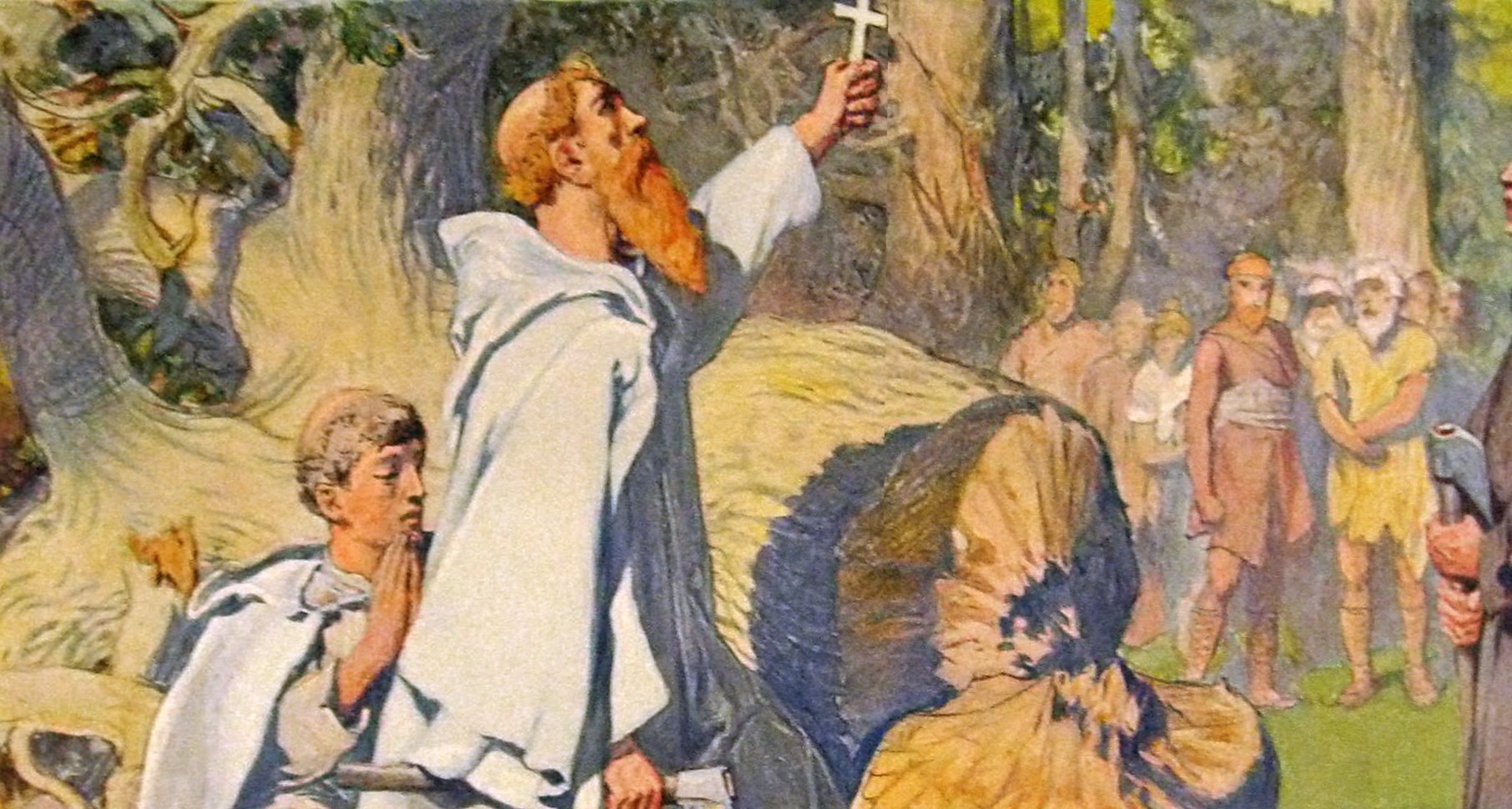
The legend of Saint Boniface is one good example. According to the story, Boniface came upon a group of pagans preparing a human sacrifice at their sacred oak, called Donar's Oak. Boniface took an axe and struck a blow at the tree, which immediately fell. He then pointed to an evergreen as a symbol of the everlasting life promised by the religion he brought to them.

From The Christmas Tree by Daniel J. Foley,
Chilton Company Book Division, NY: 1960.
The custom of a decorated and lighted evergreen began in Germany, beginning with a pyramid made of wood and lighted with candles and decorated. Since it was also the custom to bring a small evergreen inside for greenery in the winter months, it's not difficult to see how the lights and decorations moved from thelichshtock to the evergreen (usually a fir). The idea did not reach American shores until the Victorian era, making its way from Germany to England first. In many instances, the greenery was simply an evergreen bough places on a table and decorated.

My 2014 tree
Some years I have a real tree, others years we have an artificial tree, but always I bring in live greenery to decorate my house, continuing the old tradition of "bringing in Christmas."

My 2011 tree
There is nothing like the scent of pine to make me feel the season is truly here. I won't do it just yet, though, because the greens will dry out, and it's still too soon to be decorating in my opinion. I prefer to wait until we've enjoyed Thanksgiving, and then move gradually into the next season. But working on the carols program puts me in the holiday mood, and makes me look forward to the pleasures on the way.