Showing posts with label Appalachian Storyteller. Show all posts

The Lowly Roly Poly Egg: Fact and Folklore

The egg: a humble thing, really. The staple of breakfasts, the provider of good snacks, the necessary ingredient in so many recipes. The egg is as important and taken for granted as the sky above us and the earth below us. And yet, so interesting.

There are some things about eggs most of learn experience. For instance, a good egg will sink in water, but a bad egg will float. A well-done boiled egg will dry quickly when taken from the water; fresh egg, when boiled, will be a mess to peel; old eggs are glassy and smooth of shell, and might not be a good idea to use.

Did you know that at one time farmers scattered eggshells on their fields, believing that eggs represent fertility and would bring them a good harvest?

Then there is this English rhyme:

Break an egg, break a leg;
Break two, your love is true;
Break three, woe to thee.

In Ireland, people left empty eggshells outside to provide shelter for the fairies. However, others believed that witches made boats out of eggshells and used them to travel from place to place, Witches must have been quite small!
A double-yolker, as we call the eggs with two yolks, were believed to bring good luck. In reality these eggs usually indicate a young hen just beginning to lay, or an older hen getting ready to stop laying. 
An egg left on your doorstep can be very bad news, or very good, depending on what culture you are from. In Brujeria (Spanish/Latin witchcraft) it's very bad--means someone has put an evil spell on you. To break the spell you must urinate on the egg and then sweep it into the trash without touching it (who would want to?). But the egg would also indicate someone wishing you good luck and/or fertility. I'll take that meaning, thank you.
Sometimes--again, usually when beginning to lay or ending a hen's fertility--a hen will lay a very small egg. I mean like robin's egg size of smaller. In Appalachian lore, these eggs should be thrown onto the roof of your house to placate the witches. We've always just mixed them into scrambled eggs. I wonder if that was a good idea.
There are many, many other egg superstitions. Here are links to a few:
Learn Religions website

Copyright Susanna Holstein. All rights reserved. No Republication or Redistribution Allowed without attribution to Susanna Holstein.

New CD Now Available!

I am pleased to announce the release of my latest CD, Idy Mae's Full Moon and Other Stories and Songs.


The CD has stories from my husband's childhood in a West Virginia coal camp along with tall tales and songs. It's guaranteed entertainment for the whole family.

You may buy directly from me, or wait a few days and it will also be available on CDBaby and Amazon. Price is $15.00 (with free shipping if you buy from me!) Just click on this link to my other blog, Granny Sue's News and Reviews, and click on the Buy Now button on the right, or email me at susannaholstein@yahoo.com and I can send you particulars.

Another CD of ghost stories is in the works and should be ready for release in about 6 weeks, so stay tuned!

October Schedule: Lots of Ghostliness

October is filling up with ghosties! I hope I will see you at one of these events:

October 6: Ripley, WV Middle School full day storytelling

October 10: Tamarack, tour group presentation. Private event.

October 11: Philippi Library, Philippi, WV. WV Ghost Stories, 4:00 for Teen Read Week

October 12-13: West Virginia Storytelling Festival, Weston, WV. Schools event and evening public performance.

October 15: Apple Butter Making at my house!

October 17: Mountaineer Tours, Tamarack, Beckley, WV. Private event.

October 21: Road Scholars presentation, Beckley, WV 9 am

October 21-22: Ripley Ghost Walk, 8pm each evening.


October 25: Grant County (WV) Library, Ghost Stories tentative

October 28: Hurricane High School, Hurricane, WV. Storytelling and workshop

October 31: Jefferson Elementary, Follansbee, WV. Ghost stories all day

October 31: South Parkersburg (WV) Library, Ghost stories, 6:30pm

Til then, happy haunting!

Christmas Lore: The Christmas Tree

Good morning!

I spent some time reading up on the history of the Christmas tree this morning while I drank my tea. My friend Jeff and I are putting together our Christmas carols program and adding new material for this year's presentations. I always enjoy the research as we prepare the songs and stories each year.

The tree is another example of the blending of earlier pagan beliefs with the symbols and beliefs of Christianity as this "new" religion. Mistletoe, holly, a Solstice/winter celebration, the Yule log and many other aspects of earlier traditions found their way into the rituals associated with the celebration of Christ's birth. Early missionaries often found ways to link the old ways to their teachings.

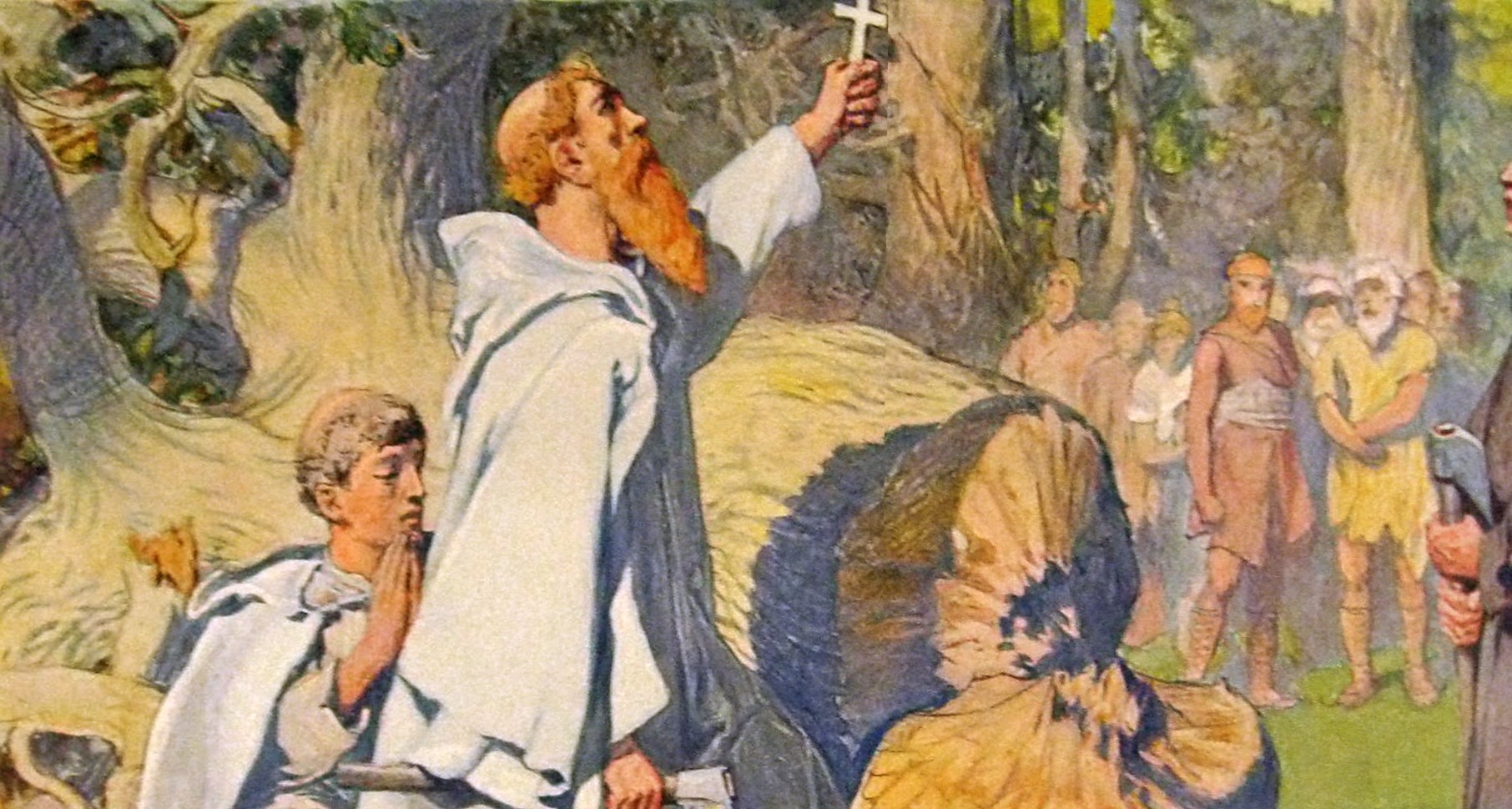
The legend of Saint Boniface is one good example. According to the story, Boniface came upon a group of pagans preparing a human sacrifice at their sacred oak, called Donar's Oak. Boniface took an axe and struck a blow at the tree, which immediately fell. He then pointed to an evergreen as a symbol of the everlasting life promised by the religion he brought to them.

From The Christmas Tree by Daniel J. Foley,
Chilton Company Book Division, NY: 1960.
The custom of a decorated and lighted evergreen began in Germany, beginning with a pyramid made of wood and lighted with candles and decorated. Since it was also the custom to bring a small evergreen inside for greenery in the winter months, it's not difficult to see how the lights and decorations moved from thelichshtock to the evergreen (usually a fir). The idea did not reach American shores until the Victorian era, making its way from Germany to England first. In many instances, the greenery was simply an evergreen bough places on a table and decorated.

My 2014 tree
Some years I have a real tree, others years we have an artificial tree, but always I bring in live greenery to decorate my house, continuing the old tradition of "bringing in Christmas."

My 2011 tree
There is nothing like the scent of pine to make me feel the season is truly here. I won't do it just yet, though, because the greens will dry out, and it's still too soon to be decorating in my opinion. I prefer to wait until we've enjoyed Thanksgiving, and then move gradually into the next season. But working on the carols program puts me in the holiday mood, and makes me look forward to the pleasures on the way.

A Storytelling Photo Journal

It was a wild ride, and it was fantastic fun. I told stories from pretty much one side of West Virginia to the other, mixing ghost tales, ballads, stories for children with a few side trips along the way.

It started in Ripley. This was the Do You Believe? Ghost Walks in my county's seat, and we started right at the courthouse steps. This year we had between 150 and 200 people come out for the walks over two weekends, even though it was right chilly the second Saturday. Civil War ghosts, town legends, old murders, historic homes, and the town's beginnings in frontier America all contributed to the evenings' tales.

Sunday I packed and prepared for the week's travels, and I was on the road early Monday morning, heading to Saint Albans, followed by Charleston and then Dunbar, telling West Virginia ghost stories at libraries in Kanawha county. No photos, unfortunately, as I was traveling solo so had no trusty sidekick to snap pics for me.

Tuesday morning found me in Clendenin, the home of the first library I managed. It is always fun to return and see how vibrant this library still is in this small community on the Elk River. I left there and headed north and east to Shepherdstown, WV in the far eastern panhandle of our state, to tell stories for the Speak! Shepherdstown series hosted by storyteller Adam Booth. The audience was fabulous for this event--seasoned adult listeners who really support storytelling in their community. After the evening show I drove west and south once again to Weston to be ready for the start of the West Virginia Storytelling Festival that started the next morning.


 This festival, held at Jackson's Mill, was excellent as always.

We told tales to about 1000 or more school children over two days, and participated in an evening storytelling concert for the public. Fun times!

This photo was taken in the WV Building--an unusual building built for a World's Fair and then brought back to WV. It's built of all the hardwoods found in our state.

The exterior of the WV Building, taken in the mist of early morning.

I left Jackson's Mill and headed south and west, taking the scenic route so I could once again visit two favorite places: Falls Mill and Bulltown.


Falls Mill is a small park on the site of a former mill, and Bulltown was the site of a Civil War skirmish.


West Virginia had no huge battles during the war but there were quite a few sizable skirmishes in the state. Bulltown was quiet when I stopped there, with no other visitors. There is an eerie feeling of going back in time in such a place when one is all alone. I almost felt the presence of the soldiers and family there.


Friday was booth day--we worked at Marietta to being new items to our spaces there. I'm afraid this booth was a little neglected lately while I've been on the road so much. It looked fine though, and we added a few new things. I'll post pics in a later post.

Then Saturday I drove to Cross Lanes for the last of my Kanawha county library performance series and then came back to Ripley for the Saturday night ghost walks. I was happy to see two people from the morning's program at Cross Lanes in attendance for the ghost walk--they drove a good ways to be there, bringing several friends with them.

I was kind of sad to see the end of this wild week of storytelling. I met so many people along the way, and West Virginia is wearing its beautiful fall coat so the drives were a treat in themselves.

Yesterday I unloaded my van, unpacked my suitcase, and then went over to Ravenswood to work on the booth there (pics coming in another post). And today? I think it's going to be a bit of a catch-up day, doing laundry, writing thank-you notes, paying bills, and all the mundane things that keep home running smoothly.

Do You Believe? Ghost Walk!

This weekend, in the beautiful West Virginia town of Ripley, we'll be walking on the spooky side of history, with tales of evil doings, strange deaths, lost graves and more. Join me for a look at the dark side of town! Sponsored by the Ripley Convention and Visitors Bureau.


Telling Tales in Middle School

Coal mining, World War II, ghosts and getting in trouble: it was a fine day for storytelling to eighth grade students today.

The middle school students will be entering stories in the local writing contest, and for the past 6 years I have visited the school to tell stories and talk about writing and what makes a good story. In past years the focus was on ghost stories but this year the students will be writing stories from the hills--stories about where they live, about life experiences and perhaps even stories from history.

I brought coal mining artifacts with me, along with letters, photos and other documents that are part of my story about my parents meeting in England during World War II. Realia can be a valuable addition to a storytelling program, particularly one that includes topics that might be unfamiliar to an audience. For children, using the letters, coal mining hardhats, lamps and other items provides a visual stimuli that enriches the experience and the story.

So we had a fine time--great listeners, good questions and participation. I had one period with no class, and was using the time to catch up on email on my phone when another group came into the library. These were a sixth grade class, I think, and they were there to read and use the computers. My display caught their attention and soon the group was around my table, asking questions, trying on the helmets and looking through the World War II notebook of documents. I didn't mind; it was my break but their interest made me happy.

Then they spotted the bottle of turpentine, and they asked what story I told with it. I asked the teacher if he minded if I told them a story, and with his permission told them a tall tale series of dog tales. They loved it, and so did I! This little impromptu telling was the highlight of my day, I think--these kids really wanted to hear a story, and how often do we come across a group this age who beg for a story? I got many hugs as they left.

This group made me appreciate the joy of what we storytellers do. While the teachers must deal day-to-day with apathetic students and curriculum standards, we get to come in and tell them stories, engaging them in a whole new way that makes them eager to hear what we have to say. Learning certainly took place with this group, perhaps unplanned and not in the textbook, but I am betting these children will remember the stories, remember how the carbide lamp worked, and maybe, just maybe, they will be inspired enough to find and write stories of their own.


J is for Jack, the Appalachian Super-Hero

This summer public libraries across the country will be presenting Summer Reading programs around the theme of super-heroes-- but who could be more super than Jack, that wily, sometimes lazy but always using his canny wit to get through troubles and tribulations.

Jack is the hero of many an Appalachian tale, and come to that, may British and European tales too. As Hans (German and Norway), Ti Jean (French), Juan (Spanish), Ivan (Russia), and others, the "Jack" persona has been slaying dragons, tricking kings, wooing princesses and outwitting ogres for centuries. So he's a natural for this summer of hero tales, I think, and I am looking forward to telling his tales to audiences of all ages.

Because that's the thing about Jack: he charms, entertains and surprises adults and teens as easily as he does children. Men in particular are drawn in to the stories about this unlikely and ungainly boy, perhaps remembering their own days of outrageous adventures. Girls like Jack because he's funny, and because he often collaborates with girls in his adventures--and he seems to like them pretty well too, as he is always trying to win over some maiden or another.

Jack tales have been in America probably since the very early days of settlement, and in what we now call West Virginia since before 1738, according to an early historian of our state, Joseph Doddridge. The stories furnished amusement for all ages in those days and continue to do so today.

So here's to Jack, a real super hero. May his adventures and exploits long live in the stories told about him by storytellers across the globe. This summer he will come alive in my programs for libraries. We'll be singing some old songs about Jack, playing out story parts with puppets and audience participation and having a fine time with these lively tales. I hope you will be in the audience somewhere along my trail.

H is for Holidays!

Here we come a-caroling!

What better time for stories and songs than the holidays? In particular, the Christmas holidays in December and early January.

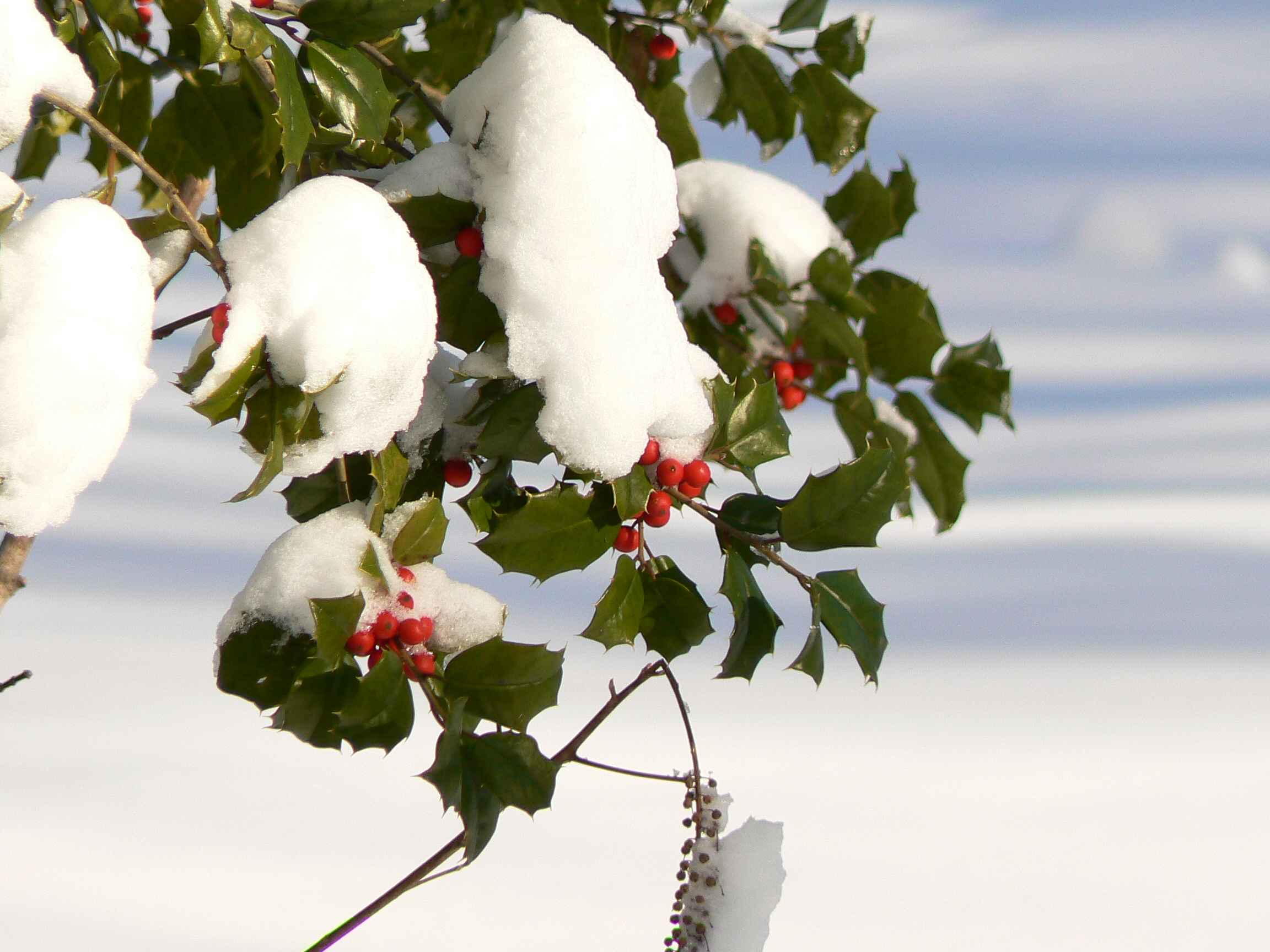
For the past three years I have been presenting a program based on the songs of the season, accompanied by the guitar and singing of musician Jeff Seager. We explore both ancient ballads and modern carols--everything from the pagan roots of The Holly Bears a Berry to the frankly commercial tales behind Rudolph and Frosty. Some we sing a cappella, some with Jeff's guitar accompaniment, many with the audience singing along, and all with the joy and spirit of the season.

Each year we seek out new material so that our presentation is fresh for return listeners at venues that have us back each year. I am constantly amazed at the wide variety of songs written for this season, and intrigued by the stories behind their creation.

We are already booking dates in November and December, so if you are looking for something different for your holiday open house or other events, give us a call at 866-643-1353 (toll-free) or drop me an email at susannaholstein@yahoo.com 

G is for Ghost Stories

"I know you might not believe this, but..." And so begins another tale of some strange, haunting experience, often told by someone who isn't sure they believe their own story. Frequently these are stories passed down in a family, laced with local superstition and folklore, and almost always well worth hearing. 

Download my story about how Burnt House, WV got its name by clicking here. It's a strange tale to be sure. This story is  on my CD of ghost stories, Beyond the Grave.


Ghost stories and storytelling have been a part of the Appalachian culture since the earliest pioneers arrived on the shores of America. People told stories to while away the time during long winter evenings or on the porch on hot summer days. Stories were a way to pass on family history, traditions, stories from the “old country,” and to teach children the accepted rules of behavior.

But why are there so many ghost stories? What gives this particular type of tale its longevity and popularity? In West Virginia, we have many such tales, from vanishing hitchhikers to malevolent peddlers to crying ghost babies. The degree of "hauntedness" varies. We are a state of storytellers, as you would know if you stood in line at any grocery store. We talk to strangers and we talk in stories, and that applies to telling someone about something odd and inexplicable that has occurred.Sometimes the stories are fragments, really, a mere whisper of a tale or piece of memory passed down as a "they say" story. Others are well-known, documented in books and occasionally on film or in photos. 

The possible reasons for the abundance of ghost stories are several. The simplest explanation might be that the mist rising from the hills at night can create a ghostly aspect that might make a person think of otherworldly beings. Some folklorists speculate that the settlers brought with them the stories and lore of their native countries. Some of these stories were transplanted with the people who told them with new twists introduced in their new land. The heritage in this part of the Appalachians is Scottish, English, Irish and German predominantly, but with a good helping of Italian and a seasoning of Polish, Russian, African-American, and many other nationalities. British folklore, particularly that of Ireland, includes revenants of all kinds, along with both little people and giants. Some of those tales were simply transplanted and adapted to a new environment. The German tales also moved to the mountains, with their often darker themes.

Religion might have played a role as well. Many settlers believed firmly in the flight of the soul after death, and it was not much of a stretch to believe that some souls lost their way on this final journey and were trapped here on earth. Usually these lost souls had a specific reason for staying: revenge, relaying a warning to loved ones, or some other unfinished business. Some ghost stories were cautionary tales, meant to discourage children from dangerous activities. In my county, there is a story of a headless dog that supposedly haunts Tug Fork after dark and chases people. Children in that area might think twice about going out after dark if there is a chance of encountering that dog.  West Virginians are religious people, and ghost stories often carry lessons of forgiveness, retribution, unrest because of a grave sin, or warnings to listen to elders. 

Then there is the environment: towering dark mountains, deep shadowy hollows, evening and early morning fogs, the intense quiet broken only the falling leaves, an owl's call, the cry of some unnamed night creature. All lend themselves to a sense of the supernatural, of someone or something watching, lurking, in the dark and hidden places along our roads.

My interest in ghost stories began when I was a child; my parents told us the story of the haunted house in Royston, England, where they had an apartment as newlyweds. Add to that the big old house in Manassas where we lived when I was young, with its chipping plaster walls, spooky basement and Civil War relics in the yard, and my fertile imagination was well supplied. When I moved to West Virginia, however, I found that I had moved to the mother lode of ghost stories. It seemed like every place in the state had a story connected with it. In my own county, I heard almost a dozen stories of haunted places or events.

As I learned more about my new home, I found the books by Dr. Ruth Ann Musick, who collected ghost stories from around the state. Many tales were brief and vague, others were more developed with names and specific locations. The stories grabbed me because they were told by ordinary people living their ordinary lives--except there were these weird things that had happened that they knew about and were willing to share.

Ghost stories are not horror stories. Ghost stories are typically stories about supernatural occurrences, rarely include violent acts committed by the spirit, and are usually fairly short.  They are generally more haunting than scary, leaving the listener wondering what might have really happened, if the person really saw what they claimed, or why the ghost chose that place or time to appear. The haunting, unexplained nature of ghost stories probably explains their continued popularity. There is mystery in ghost stories that engages the imagination. Many ghost stories have been collected and published in books; still others are still being passed down from parent to child.

There are, of course, different kinds of ghost stories. My focus is on the stories told to me as true events or that I have found documented in some way (books, newspaper clippings, etc). I do tell some of the fictional, folk stories and not-too-spooky stories for young audiences, but my primary interest lies in the "true" ghost stories. 

Some storytellers prefer the ""jump" tales of campfire popularity, others the horror stories and literary ghost tales. All have their audiences. 

For those interested in the type of stories I tell, I offer the following excerpt from my ghost stories workshop for those interested in telling ghost stories reported as actually happening or with a historical basis :

The brevity of ghost stories and the general lack of detail means work has to be done to create a performance piece. This can be accomplished by placing the story in a frame--developing the who, what, when and where of the story. 

Build the Story’s Frame:

1    1.  Time: when did the story take place? If no date can be established, when did your informant hear of the story—how old were they? What were the times like then—i.e. Depression, wartime, post-war, Vietnam era. Set the story in a time period. Historic events? Local history? Local industry or occupations?
 
2.       Place: where did the story take place? Rural, city, West Virginia or another state? In a house/store/other building, or in a field/graveyard/street, etc? What did the place look like during the time period of the story?
 
3.       People: who told you the story? Who told it to them (if it wasn’t a personal experience)?Who were their people? Who were the main characters in the story and how did they happen to be in the place where the events occurred? 
 
4.       What happened? Are there other accounts of the story/events from other/perspectives/others involved? Are there similar stories in folklore? Is the event recurring, or was it a one-time happening? Is there a specific date/time/circumstance that lead to the event, i.e. a holiday, or a storm, the presence of a particular person, an anniversary date?
 
5.       Why does your informant think the events happened? Are there superstitions/beliefs involved? Did something occur to stop the recurrence of the event?
 
Place the Story in the Frame:

6.       What perspective will you use to tell the story—what narrative voice? 
 
7.       Now that you have gathered all this information, how much of it is relevant to the story? How much does your audience need to hear, and how much of it is really to inform your telling (and to be able to answer questions later)?
 
Dig Deeper—the story in 3D

8.       Is there something to be learned from the story, some moral, lesson, warning, etc? You may not want to state this specifically in the telling, but being aware of them can influence your interpretation of the tale. Is there an underlying universal theme—love, hate, loss, longing, regret, revenge? 

      9.   Build in the senses: evocative scents, sounds, surroundings. Show with the gestures, voice and expression as much as possible rather than using extensive descriptions for such things as the roughness of fabrics or the softness of a touch, etc.

Hang the Story in Place

10.   Circling back: Summarizing/ending the story. Conclusions drawn? Impact of the story on the place/people/time? What is left today—Buildings? Descendants? Place names?

I've posted many ghost stories on my other blog over the seven years I've been writing online. Here are a few you may want to read:

This ghost story was written from a brief account in a newspaper article.

The story my parents told about their haunted house in England.

A couple of ghostly poems; and here is another. And a classic from Thomas Hardy.

Ghost story and comedy, all in one! The Gatehouse Ghost story is a true story that happened to me.

Links to other ghostly information.

Strange photos we took at the old Moundsville State Penitentiary, which now does ghost tours.

Raw Head, Bloody Bones was a look into the background of this chilling tale used to scare little children.

A recipe for Bony Fingers? Why not?

Jump Tales for Halloween--just the bare bones, but easy to develop for telling.

West Virginia's most famous ghost story, The Greenbrier Ghost. This is on my new CD Beyond the Grave both as a ballad and a story. 

A ghostly tale from Rowlesburg, West Virginia.

The Wizard Clipp, another famous story in our state. Another one that's on my new CD.


A short tale, easy to tell.

I've written about the "why" of ghost stories before; this older post contains a good booklist.

A true story of something that happened to me. It still gives me shivers to remember it.

One of the stories from Jackson County, Sidna is a tale I often tell. It's on the CD!

A story told to me by a young girl, this story is on my new CD too.

Want a copy of my new CD, Beyond the Grave; Ghost Stories and Ballads from the Mountains? Email me at susannaholstein@yahoo.com and I can tell you purchase details.

F is for Family

There are so many ways to interpret the title of this post.

I could talk about the importance of family stories and how these stories deepen our appreciation and understanding of our heritage. I could bemoan the loss of family time and communication as today's families speed along on widely different paths and seldom spend real time together.

I could talk about telling stories to family audiences, those performances when the audience ranges in age from newborn to ninety, when babies cry and toddlers wiggle and everyone has a great time listening. I could delve into the bag of stories that work for these audiences and why those tales work and how to modify a story so it too can be put into the family story bag.

I could talk about the family of storytellers and the ways we connect and support each other's work. I could extol the valuable assistance we offer each other through our listservs, Facebook pages, guilds and associations.

But I want to talk about the world family and how storytelling connects us all through universal themes, reminding us that we all share the same hopes, dreams, grief and joy. I see storytelling as an essential tool in the search for peace and understanding.


One of the stories I am telling this summer is based on Aesop's fable called The Bundle of Sticks, and it is a good example of how stories can connect us:

A father has five sons. Those boys do nothing but argue and fight all day, every day. The father is getting old and the continuous fighting is making him feel even older. He feels beaten down by harsh words and meanness. And he worries.

"I want to leave my farm to my sons to work together when I am gone," he thought. "But their arguing and fighting will surely cause them to lose their crops because they will never agree on when to harvest. The stock will be lost because they will argue over who should fix the fence. The buildings will fall into ruin because they will fight over which one should climb up to repair the roofs. Ah me, what am I to do?"

Finally one day the old father had an idea. He called his five sons to him and handed each of them a stick.

"Now," he said to the oldest son, "break your stick."

The son did so easily. The father moved to the second son, the third and so on. Each son easily broke the stick the father had given him.

"What's the point of this, Father? You're wasting our time with your foolish game!" the oldest son snarled.

"Maybe so, Son, maybe so. But before you leave, please take this bundle of five sticks and break it for me."

The oldest son grabbed the bundle and tried to break it. Sweat popped out on his forehead as he strained to break the bundle.

"Let me try!" said the second son. But he too was unsuccessful. All five sons tried to break the bundle but none of them could do it though they tried until their muscles were sore and their hands were blistered.

"My sons," said the old father, "you are like these sticks. Individually, you all will break but together you are strong. Work together and you and your families will prosper; continue fighting the way you have been, and you will surely be broken, and lose everything you own."
-----------------------------------------------------------------
What parent does not worry about their children's future and feel exasperated when their children fight? What children have never argued with their siblings? Touching on such universal experience brings us together, and we can all feel the father's stress and love in this tale. At the same time, we can see how standing together can unite us in the face of adversity and make us stronger and better able to face the future.

Whenever a storyteller begins a tale, the audience before them slowly merges into a family of listeners. Sharing a story brings people closer together, shared experience and emotion creating a bridge that crosses over the divides of gender, age, race, economic levels, religious beliefs and politics. I cannot think of anything other than art that can have this impact on a diverse group, and of all the arts storytelling is the most personal, the most direct, and probably the simplest. I tell a story, using only my words, gestures and body language, and together the audience sees a world spread before them--a world with characters, scenery, history, adventure, and wisdom.


D is for Depending on the Audience

If a tree falls in the forest and no one hears it, will it make a noise? This applies perfectly to storytelling: storytelling doesn't happen without an audience. And storytellers depend on the audience in many ways.

Besides being simply a physical presence, the audience provides clues and cues for the teller. Intense listening, a questioning look, laughter, a sudden intake of breath, and even stirring in their seats all send the storyteller a message. For example:


  • A questioning look in a listener's eyes may mean the teller has used unfamiliar vocabulary. In the next sentence or two, the teller can clarify by building the definition into the story narrative.  If I said "he was feeling peckish" there might be some in the audience who would not know that Appalachian term. I could clarify by adding, "so he went looking for something to eat" which defines the word and keeps the story flowing.
  • laughter usually means the audience is with the story and comfortable enough to laugh aloud. Most people will only smile at something funny if they aren't comfortable in the environment or with the people around them. Laughter at the wrong place signals the teller to work on that section of the tale next time. Maybe he/she hadn't taken the audience deep enough into the tale, or maybe it was choice of words, or it could be simply where the event is taking place--funny in one venue might not be funny in another. I
  • An intake of breath--ah, they are really into the story and feeling what the character feels!
  • Stirring in their seats can send different messages. Stirring, looking around, whispering or talking to their neighbor very likely means "get to work, storyteller! You're losing your audience!" It could be the story was not the right one for this group; in that case the teller can shorten it up, hasten the end and move on. Sometimes inserting a question to which the audience must give some sort of response can bring them back into the tale. There are many distractions that can keep an audience from focusing: a door opening, a child crying, the lateness of the hour, too long in their seats at an event, too warm or too cold, etc. The storyteller makes lightning decisions as to what might be disturbing the group and then work with the audience to overcome the problem and get everyone back to the story. I remember one event being held in a large barn that was also used for cattle auctions. Flies were everywhere and the audience kept moving and talking to each other about it while the tellers before me were performing. When it was my turn, I acknowledged the fly problem and had everyone wave their arms in the air to scare away the flies. Everyone laughed and relaxed. The flies didn't leave, of course, but we were all more comfortable with the situation and could move along.
There are many other audience cues a storyteller will pick up on during a performance, and often the teller will make subtle changes that the listeners are not aware of. This is one reason why it is important for a storyteller to see the audience's eyes during a performance. Most performances done on stage require stage lighting; for storytelling the best lighting is if the audience lights are at least partially up so that the audience is not lost in the blinding glare of the stage lights.

Storytellers also depend on their audience for feedback after a show. Comments, memories, questions, and other interactions give us food for thought. I have heard, and been given, many good stories by listeners after a performance. A question may make me realize I need to clarify a point in the story, a hug means I have touched that person and connected with them, and that is a real reward.

So storytelling is a two-way street--the teller sends the story out, and the audience's reaction to the story feeds the teller vital information both during and long after the tale is ended.

C is for Crow

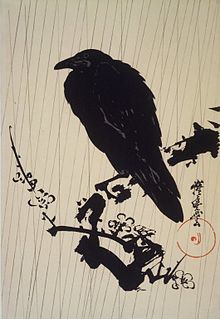
Crow on a Branch - Kawanabe Kyosai(1831–1889)
A small crow was sittin' in an oak
Watchin' a tailor cuttin' out a coat. 
Hey hey-oh! said the small little crow.
Fol-de-riddle-diddle-eye-dee-oh!

So begins one of my favorite folk songs; I call it "The Crow Song," but it is also known as "The Carrion Crow," (with variations in the wording) and as a British nursery rhyme. It is one of numerous examples of how the old songs changed during their journey to the Appalachian mountains. Crows have long been associated with death, among other superstitions; perhaps calling a group of crows a "murder" has its roots in that superstition?


Seeing a "black crow" is considered bad luck, but that leaves me wondering what other kind of crow could possibly be seen, since all the crows I am familiar with are black! Are they all bad luck? Hardly seems fair to the crow. My husband calls mourning doves "rain crows" and believes that hearing one means rain is on the way. He says that his family and neighbors in southern West Virginia always called them rain crows and I had to prove to him with photos and books that his rain crows were actually doves.

The crow is often confused with the raven and the the folklore associated with each is also intermingled. The crow, in some cultures, was seen as a messenger from the gods and believed to be the bringer of messages of prophecy and either good or bad omens.

Some other superstitions attached to crows:
  • a dead crow in the road is a sign of good luck (but not, apparently, for the crow). This probably comes from the practice of hanging a dead crow in the garden to frighten off other crows. As one old-timer told me, "The only good crow is a dead crow."
  • Seeing two crows flying together is considered good luck in some places, but bad luck in others. I guess it all depends on where you live.
  • a crow on the roof means Death is on the way to the house.
  • A Missoula cemetery website offers this advice: "One crow = Bad luck. Two crows = Good luck. Three crows = Health. Four crows =Sickness. Five crows = Death. Lots of other interesting graveyard folklore in this document.

My husband's father once had a crow as a pet. We know now, of course, that it isn't wise and is in fact illegal generally to keep wild creatures as pets, but back in the 1950's no one thought much about it. Chuck (Larry's dad) had a variety of wild animal pets from time to time: raccoons, groundhogs, squirrels, a fox--so when he found a baby crow he naturally brought it home. The family raised the crow on a doll bottle at first, then gradually moved on to other foods as the crow, now named Jimmy, grew. They had him for 7 years until an unfortunate argument between Jimmy and the hogs lead to Jimmy's demise. Larry has many tales about his crow, and some of them have become a story I sometimes tell.

Crows feature in the folklore and stories from countries around the world. Wikipedia says that "In Chinese mythology, the world originally had ten suns either spiritually embodied as ten crows and/or carried by ten crows: when all ten decided to rise at once the effect was devastating to crops, so the gods sent their greatest archer Houyi, who shot down nine crows and spared only one. This mythology comes from a text in Shanhaijing, among other sources.[49]" 

Aesop certainly knew a thing or two about crows; the story of the crow and the pitcher is a good example:

A Crow, half-dead with thirst, came upon a Pitcher which had once been full of water; but when the Crow put its beak into the mouth of the Pitcher he found that only very little water was left in it, and that he could not reach far enough down to get at it. He tried, and he tried, but at last had to give up in despair. Then a thought came to him, and he took a pebble and dropped it into the Pitcher. Then he took another pebble and dropped it into the Pitcher. Then he took another pebble and dropped that into the Pitcher. Then he took another pebble and dropped that into the Pitcher. Then he took another pebble and dropped that into the Pitcher. Then he took another pebble and dropped that into the Pitcher. At last, at last, he saw the water mount up near him, and after casting in a few more pebbles he was able to quench his thirst and save his life.


This reminds me of Mark Twain's story about the blue jay trying to fill a cabin by dropping acorns down the chimney. The result was a bit better for the crow trying to fill his pitcher, a more reasonable goal.

My Dad used to say this about planting corn: "one for the rain, one for the drought, one for the crow and one for me." This is close to a saying collected by the Missouri Folklore Society: "One for the rook, one for the crow, one to rot, and one to grow."

Other crow stories and songs:
The Fox and the Crow, from Aesop: Wikipedia gives information and links to many versions of this fable, including musical ones.

The Native American tale Rainbow Crow is retold by S.E. Schlosser here. You can find many legends of the Native American Crow people on this site.

Story-Lovers has a plethora of links, books and more, all about crows.

Crows continue to intrigue scientists too. Find out about some current research and findings at the Cornell website.

I'll wrap up this post with another favorite ballad called The Twa Corbies. It's also known as The Two Crows. Some years back a storyteller whose name I cannot recall taught it to me as Biddy McGee McGaw which is very close to this version, also from the Appalachian mountain region:


"The Three Black Crows." 
Obtained from Miss Mary Franklin, Cross­nore, Avery County, North Carolina, August n, 1930. (From the Traditional Music website) 
1. There were three crows sat on a tree,
   Old Billy McGaw McGee!
There were three crows sat on a tree,
Old Billy McGaw McGee!
There were three crows sat on a tree,
And they were black as crows could be,
And they all flapped their wings and cried,
"Caw! Caw! Caw!"
And they all flapped their wings and cried,
"Caw! Caw! Caw!"
2. "What shall we have for bread to eat?"
    Old Billy McGaw McGee!
"On yonders hill there lies a horse."
Old Billy McGaw McGee!
"We'll perch ourselves on his backbone,
And pick his eyes out one by one;"
And they all clapped their wings and cried,
"Caw! Caw! Caw!"
And they all clapped their wings and cried,
"Caw! Caw! Caw!"