Showing posts with label storyteller. Show all posts

House Concerts: A New Way to Entertain

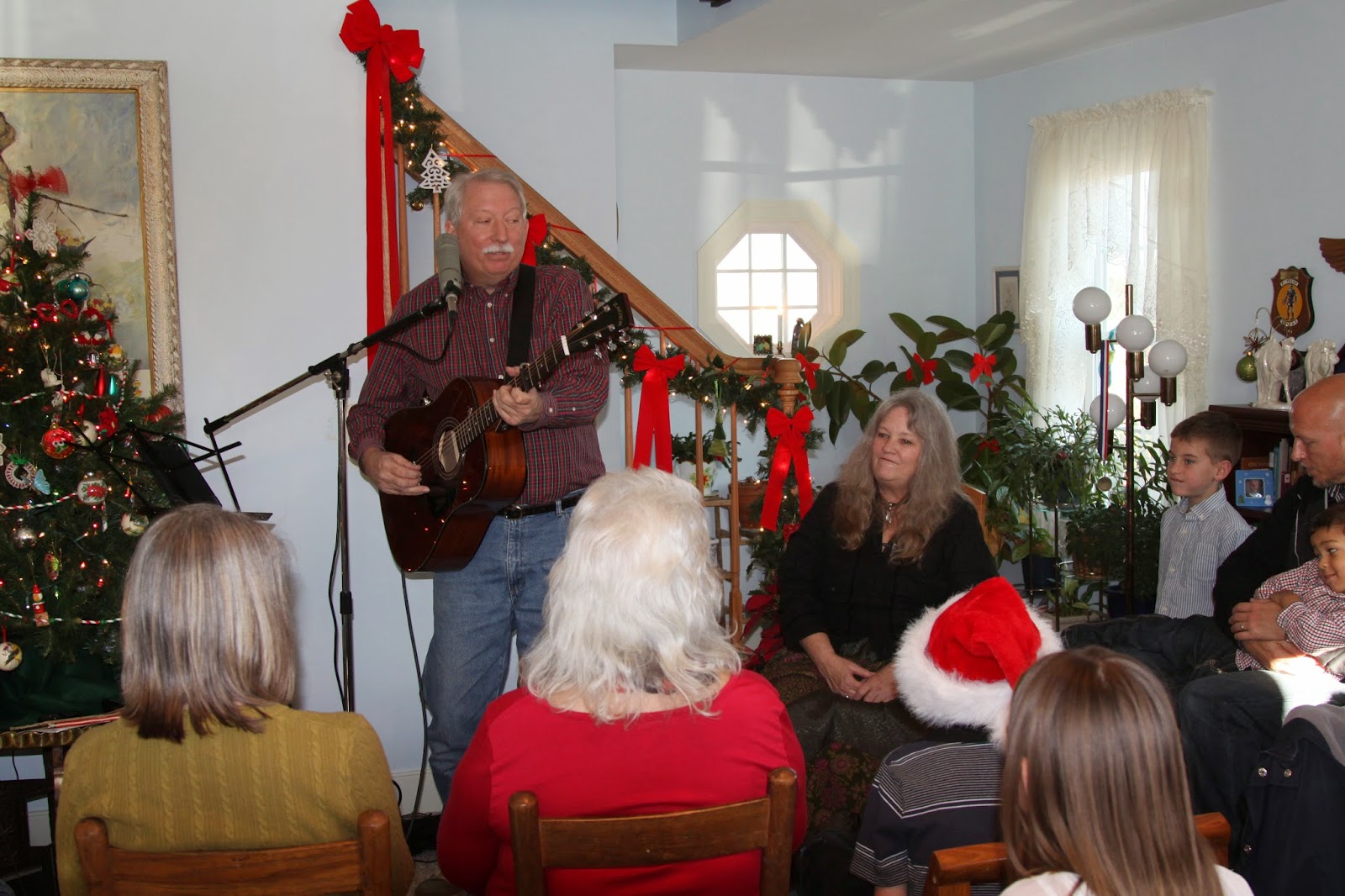
Planning a holiday party? Or just want to have some friends over for a nice evening of entertainment and talk? Then consider a house concert.

Most of us plan parties or get-togethers of some kind during the year, and these events usually follow a similar path: munchies, liquid refreshments, perhaps dinner and music. But imagine adding a new twist: a storyteller to entertain your guests with tales wild and wonderful, true and maybe-true, outrageous and touching, humorous and uplifting.

House concerts have taken off across the nation as a different and enriching touch to the usual party. Storytellers, musicians and poets are finding the venue perfect for intimate, informal presentations of their work to audiences who may be new to their artform. For the host, a house concert bumps up their event a notch, making it not only an evening of fun but one that supports the arts. Concerts can be planned for family audiences or adult-only groups.

I have been lucky enough to be invited to present at several house concerts over the past two years. It is always a pleasure--good people, good refreshments, inviting surroundings and the opportunity to interact personally with small audiences of appreciative and attentive listeners. Many performers today are often able to book enough house concerts to enable them to travel across the country to distant events. The house concert is becoming a viable income source for many a struggling artist.

How does it work? It's simple enough. The host plans a party and invites his/her friends. How many depends on the space available but 15-40 seems to be the usual number. Food and beverages are provided by the host, and sometimes the event is a potluck with attendees also providing some of the refreshment. Each guest is asked for a "donation" of a specific amount, generally in the $10-$20 range. The money collected goes to the invited performer.

Where else can one attend a concert where they can interact with the performer and get quality, often homemade refreshments for that price? It's a great deal for everyone involved: the hosts have a great event for their friends with minimal effort and cost, the guests have a fine evening out, again at minimal cost, and the performers make enough, hopefully, to make it worth their while.

If you are interested in a house concert, get in touch and I'd be happy to discuss it with you. Call 866-643-1353 tollfree, or email me at susannaholstein@yahoo.com and let's get started talking about your event.

Storytellers' A to Z Blog Challenge: Apple Tree Folktale

A recent challenge has storytellers posting on topics from A to Z, literally. I decided to join the fray, so here is my first post on the letter A. And what better source of stories for the heart and mind than apples? Here at our homestead apples are a regular part of our diet. From eating them raw to applesauce, apple cider, apple butter, fried apples, apple pie, apple cake, dried apples and just about any other way they can be prepared, apples are just plain delicious. The fruit plays a role in many stories, songs and poems, too. Here's a small selection of some of my favorites. And for more about what we do with apples here at home, check out my other blog's postings about our favorite fruit.

The Apple Tree: An Aesop Fable

A peasant had growing in his garden an apple tree which bore no fruit at all. It served only as a place for crickets, grasshoppers and sparrows to get out of the heat. The little creatures often sat chirping in the tree's branches.

Disappointed that the tree produced no fruit, the man decided to cut it down.

"Please don't destroy our tree," the grasshoppers said. "Where will we sit and chirp if there is no tree here?"

"Please don't cut this tree," begged the birds. "We sit in its branches and sing to you every day. Would you not miss our songs?"

"Please leave the tree alone," said the crickets. "We rest on its bark and make our music to lighten your work. Where will we go if you cut the tree?"

"No," said the man. "The tree gives me nothing. Why should I keep it in my garden? At least its wood will warm me in my fires this winter."

The man picked up his axe and gave a mighty swing. He quickly discovered that other creatures were living in the hollow center of the tree: honeybees! The large swarm buzzed angrily as it protected its large store of honey.

"Aha!" said the man. "This tree is worth keeping after all. Who knew that it contained such treasure?" He picked up his axe and left the tree standing, and its inhabitants continued to sing, chirp and buzz.

Cider Apples

When God had made the oak trees,
And the beeches and the pines,
And the flowers and the grasses,
And the tendrils of the vines;
He saw that there was wanting
A something in His plan,
And He made the little apples,
The little cider apples,
The sharp, sour cider apples,
To prove his love for man.

Unknown (from the website Food Reference).

Here's to thee, old apple-tree,
Whence thou mayst bud,
and whence thou mayst blow!
And whence thou mayst bear apples enow!
Hats full! caps full!
Bushel—bushel—sacks full,
And my pockets full too! Huzza!
--James Herrick

And then, of course, there are Love Apples:


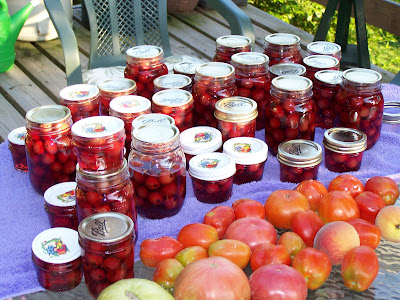
Tomatoes, you might know, were once thought to have aphrodisiacal properties and were called "the devil's fruit" by the Catholic Church.. Meaning you might be looking at your mate a little differently after eating them. Early herbalists believed that tomatoes were poisonous and many people avoided eating them; you can read more about the tomato's checkered paston this great site, The Tomato Guru. This might have been because the tomato is a member of the family if nightshades, and some of its relatives in this family can be toxic. An early herbalist named John Gerardwrote a book in which he cautioned against eating tomatoes and his words carried weight in the 1600's in England and the early US colonies. 

According to the website Tomato Casual, "It is said that if you place a large red tomato on your windowsill, it will scare away evil spirits. You could also choose to place it over the hearth — this is supposed to bring prosperity to the house. Another way to gain money is to place a tomato peeling over your door, which will bring money within four days." I think I might have to try that tomato peeling over the door. (I found another source that noted the tomato on the windowsill belief as coming from Italy : "Tomatoes are also the subject of superstitions. “Some Italians,” reports one treatise, “put a large red tomato on the mantel to bring prosperity to the house. When placed on the window-sill, or in any opening, it wards off evil spirits, and protects the occupants of the house” (DeLys 1989, 249).")

For more fascinating reading about tomatoes, check out these sites:

The origin of the Mortgage Lifter tomato variety: did you know it came from Logan, West Virginia? 

Then there's Aunt Ruby's Green Tomato, which apparently started out in Germany--where tomatoes were called "wolf peaches," and there is a folktale, according to many sources, in which witches turned people into wolves by feeding them tomatoes. I've yet to track down that elusive story, though.

A lesson plan with a story about how food gets to our tables.

What would spaghetti be without tomatoes? Check out Storytelling, Cooking and Kids for the words to On Top of Spaghetti and all kinds of other great activities to do with kids in the kitchen.

Have you ever heard of beating your tomato plants with a broom? Hmmm....

Happy telling! 


Why Tell Stories?

It's a question I have to ask myself from time to time. The quick and easy answer is because I enjoy doing it, so I have to ask: why do I enjoy it? Again quick and easy rears its head: because I like sharing the stories with others. That's not the whole answer though, as any storyteller knows. It's more complicated than that.

When I began telling stories, I just wanted to be able to engage preschoolers by using puppets and other props besides books. I loved reading aloud, but there were times when the book limited my ability to interact with the children. And sometimes they just got tired of listening and sitting and wanted to do more. So I began incorporating other methods of storytelling into story hour. I used flannelboards, fingerpuppets, movement activities, and music. Then I found a little ant puppet with a story on its tag (many of the Folkmanis puppets come with a story). I was hooked. I learned that story, and another and another. I began expanding my range to include older children and longer stories. Eventually I added family adult audiences too.

There is nothing quite like a group of people of any age listening together and sharing a voyage of the mind into the story's realm. When I see audience members looking at each other to share the joy or poignancy of a moment, I know the story has succeeded. When I see children's eyes with a faraway look, staring an me without blinking and then sighing with satisfaction at the end, I know the story has succeeded. When I see the audience explode with laughter, I know the story has succeeded.

Entertainment is important to our health. We need opportunities to escape the humdrum, to experience new ideas. Storytelling can carry audiences across oceans and time to distant lands and worlds long past, to imagined places and fantastical events. At the end of a session, it can feel like we're disembarking from a flight and getting our land legs under us again.

Of course, there is more than entertainment value in storytelling. We can explore other cultures and find new understanding and appreciation of the ways of other peoples; we can puzzle through a mystery, learn history, and discover unexpected facets of our own culture. Old myths come alive in a storyteller's mouth; stories that might have seemed dry and difficult to read gain sudden luster when told with vocabulary that fits our modern tongue.

Still the question remains, why do I want to tell stories? Beneath all the very good reasons above, the fact is that I want to share, and I want to see the art of storytelling pass down to new generations. As electronic media engulfs our lives, I want others to experience the simple joy of telling or hearing a story, told by a live person and not by an iPod, computer, television or other device. I want stories rich with years of aged patina to continue developing their gloss and avoiding the lacquer of shiny temporary hype that strips their deeper meaning and trivializes their relevance. Communication, person to person, is critical to our mental and physical well-being; instead of passively watching as we do with television or movies, when we listen we actively engage with the story and the storyteller, creating mental images unique to our experience. No video game can equal the richness of the inner tapestry we weave as we listen to a story.

This is not to say all electronic media is bad! I am using it right now to convey my thoughts. There is a time and place for everything. I want to make sure that storytelling and story listening are not crowded off the stage by technologies that purport to be the "new" storytelling media. The storyteller, with voice, gestures and eyes uses some of the oldest technology as he or she practices the art.

It is a technology that requires only two people, the teller and the listener, but it's a technology that can engage thousands using the simple gift of the human voice to transcend time, gender, distance, economic barriers and the daily human struggle. To bring people together in a common bond, a shared moment of community, to remind myself and my audiences that we all share this human condition--that's why I tell stories.

Storytelling, Naturally

Recently I had an opportunity to spend three days with five other storytellers, working stories, marketing, technique and most importantly sharing time together. We cooked, sang, talked, laughed and immersed ourselves in our craft. We also made time to walk in the woods surrounding our hosts' home.

It seemed an odd juxtaposition: I left my home deep in the hills of West Virginia to drive to a major airport, fly several hundred miles and then go to a home in the suburbs. Yet around this home were deep woods with trees so tall I was awed--and I live in the woods. Green vines covered the ground, and the nature trails we walked often bordered a rippling brook with waterfalls and interesting rock formations. As we walked I saw familiar plants: spicewood, sassafras, cleavers, violets, jack-in-the-pulpit and many others. I broke a few spicewood leaves to inhale the strong perfume of this  aromatic (and useful) plant. I found pokeweed ready for harvest and creasey greens long past eating but lovely with their yellow flowers. We saw a downy woodpecker feeding its young high in a dead tree and listened to the melodious song of the wood thrush. After each walk I returned to work relaxed, calm and somehow soothed by the time we'd spent in the woods.

Recent studies have identified a problem in our society that highlights the disturbing trend, particularly among younger generations away from nature and outside activities. We see it daily in our travels when we pass empty playgrounds and note the quiet suburban streets where there are no bikes, roller skates, swings and children's laughter echoing in the evening air. Children seem to prefer indoor pursuits these days and few can identify the plants and animals in the world outside their homes.

Most of us in the boomer generations have happy memories of playing outdoors, making bows and arrows from sticks and string, shooting the seed-heads of plantain, sucking honeysuckle blossoms and holding buttercups under our chins to see if we liked butter. We wore daisy chains and jewelweed earrings or made fairy gowns from hollyhock blooms. Some of us foraged for berries and nuts and others may have gone fishing or hunting. Others swam in a creek or river, swinging from a grapevine over the water. We caught bugs, tracked animals (even if it was the house cat), and spread blankets on the ground to watch the stars at night. On weekends we went on Sunday rides with our parents, taking along a picnic lunch to eat at some pretty spot along the way. 

Many of today's children have little or no contact with nature outside of groomed lawns, mulch-covered playgrounds and perhaps during a zoo or park outing. This lack of connection to the outside world results in "diminished use of the senses, attention difficulties, and higher rates of mental and physical ailments," according to Richard Louv, author of Last Child in the Woods, a study of almost 2000 children, published in 2008. 

Storytellers have a role in reconnecting children to the environment. We carry stories, legends, and folklore that help explain the hows and whys of our world, and why the environment should be understood, appreciated and protected. Contact me or any other storyteller and find out how we can help you bring nature to your children in ways they will love and understand. Stories and nature: it's a natural!

The Fairy Cup

Ah, the magic of the old stories! We're getting close to March, the season for stories of fairies and the little people. Here's a bit from a story that paints vivid images in my head. A man who stumbles upon a fairy dance, and what ensues.

 “...Seeing a door open in the side of the barrow he went up to it and looked in, and there he beheld a large and luminous house, full of people, women as well as men, who were reclining as at a solemn banquet. One of the attendants, seeing him standing at the door, offered him a cup.

He took it, but would not drink, and pouring out the contents, kept the vessel. A great tumult arose at the banquet on account of his taking away the cup, and all the guests pursued him, but he escaped by the fleetness of the beast he rode, and got into the town with his booty.

Finally this vessel of unknown material, of unusual colour, and of extraordinary form, was presented to Henry the Elder, King of the English,as a valuable gift ; was then given to the Queen's brother, David, King of the Scots, and was kept for several years in the treasury of Scotland. A few years ago, as I have heard from good authority, it was given by William, King of the Scots, to Henry the Second, who wished to see it."

Excerpted from The Fairy Cup, in Folklore and Legends of Scotland by Charles Tibbits.


Image of the Dunvegan Fairy Cup from Wikipedia.

Begin Again


I am reminded, as this new year begins, of the words of the poet Susan Coolidge:

Every day is a fresh beginning,
Listen, my soul, to the glad refrain,
And spite of old sorrow, and older sinning,
And troubles forecasted, and possible pain,
Take heart with the day, and begin again.

It is a time of endings and beginnings, as we look back at what has passed in the last year and consider what faces us in the new. It is a time when we can say, "Enough of that," and set our sights on a new path. It is also a time when we store away in memory the best the year brought to us, to be brought out and savored when we need a boost.

It is also a time to look at what we resolved to accomplish in the past year--what actually happened and what still waits. Or perhaps the priorites changed and what once seemed important has fallen from the list.

In Germany, I have read, there is a custom of visiting those with whom one has quarreled and all of the past disagreements are mutally forgiven and forgotten. In this country, we need such a healing ceremony after the rifts of the political wars. I could use some of that custom in my own life too, to melt away some hard feelings. Couldn't we all, for that matter?

So it is each new year; we begin with high heads and confidence. Life may beat us down as we trudge through the days, until finally we drop our cares at the holidays and look ahead with renewed hope. Somehow the thought of that cycle is comforting--no matter how bad things may be, there is yet one more year to look forward to, one more chance to get it right, and one more opportunity to celebrate this strange journey we call life.

Take heart, and begin again.


Copyright 2012 Susanna Holstein. All rights reserved. No Republication or Redistribution Allowed without attribution to Susanna Holstein.
Yesterday was a storytelling day: telling tales to students at a community college. The emphasis was on Appalachian culture and the stories and ballads told within that culture, their history and the outlook for the future.

Many students in this class had never heard a storyteller before. The ballads was also new to most of those in the audience, although there were some who remembered their grandparents singing to them, and others had stories passed down in their families.

What is it about our Appalachian culture that makes our stories unique? I believe it is our sense of place, our connection to where we are from. Our mountains and waters are how we define ourselves; we know our roots and hold on to them even if life moves us to a different geographic area. The mountains themselves provide the backdrop and underpinning to our tales and quite often provide the material too. When we speak of nature, we do so with familiarity. We watch the rivers for flooding and icing, the mountains for slips and slides, for the greening of spring, the richness of gardens and the changes of fall. We know wildlife and its ways; we watch weather and predict it based on what nature shows us.

Another defining facet of mountain life is its people. Independent, or at least preferring independence in how we live our  lives is predominant. We prefer to make our own choices and aren't too happy with government interference. Providing for ourselves through gardens, cutting firewood for heat, and finding income from a variety of sources (what my husband calls "jake-legging around") is part of life for a large percentage of people.

We are spiritual people. Not religious only although religion is a basic of life for most.  By spiritual I refer to the acceptance of a divine presence that abides in our world, and the belief that we can readily communicate with that divine through prayer, thought and action. Sometimes this spills over into superstition, a conviction that doing or saying certain things at certain times might impact future events, health or relationships.

Our sense of place, independence, and spiritualism underlie the stories we tell: hunting stories and Jack tales usually have the hero triumphing through prowess or "smarts." Ghost stories tap into the connection with nature and spirituality and belief in the ability to feel or see what others may not. The old mountain ballads,sometimes called love songs by older generations, tell stories in musical form, sometimes telling historical tales or stories based in long-ago legends from the British Isles.

The class listened intently. I could see by the eyes watching me that there were stories behind the intentness of their gazes. I only wish there had been time to listen to them. After class several stopped me to tell me a quick story or to reiterate how much they enjoyed the session.

But I am sure that no one enjoyed it as much as I did. There is no match for the joy of telling a story and seeing the story come alive in the eyes of the listeneres.

2012 has started with a busy schedule of storytelling ahead. I hope to see you somewhere along the way as I present workshops at the Sharing the Fire Conference in Albany, New York and at the OOPS Storytelling Conference in Mount Vernon, Ohio. Or perhaps our paths will cross at the August Heritage Series Old-Time Week, where I will be teaching a weeklong workshop on Appalachian storytelling, or at the West Virginia Vandalia Festival, the West Virginia State Folk Festival or the WV Book Festival or the West Virginia Writers Conference. Maybe you will be in the audience at a school performance or at a library summer program.

The year is full of possibilities for meeting new friends and hearing new stories. Here is a story for today:


The Drop of Honey
 (adapted from the Thousand and One Arabian Nights)